



Question: Problem 3: An extremely large, thick concrete slab (k-1.4 W/m-K, p 2300 kg/m3, cp-880 J/kg-K) is initially at a uniform temperature of 27C on a
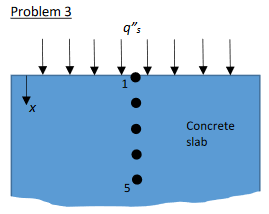
Problem 3: An extremely large, thick concrete slab (k-1.4 W/m-K, p 2300 kg/m3, cp-880 J/kg-K) is initially at a uniform temperature of 27C on a cloudy day. The clouds suddenly part, and the top surface of the slab absorbs a solar radiation flux of qs"-1400 W/m2. Assume that convection and emitted/reflected radiation are negligible. (a) Using the explicit transient finite difference method with five nodes, where the nodes are spaced 1.5 cm apart, determine equations for nodes 1-4 that will enable you to calculate the temperature at timestep p+1 (i.e., TP+). Leave the equations in symbolic form. Because the slab is so thick, assume that node 5 remains at a constant temperature (meaning that you don't need an equation for that node). (b) Solve the equations for the node temperatures from t=0 to 300 seconds, using a timestep of 30 sec. Plot the temperatures of the nodes versus their x-distance, at the start of the heating (t-0), at 120 seconds, and at 300 seconds (i.e., your graph should have 3 separate curves) WI Problem 3: An extremely large, thick concrete slab (k-1.4 W/m-K, p 2300 kg/m3, cp-880 J/kg-K) is initially at a uniform temperature of 27C on a cloudy day. The clouds suddenly part, and the top surface of the slab absorbs a solar radiation flux of qs"-1400 W/m2. Assume that convection and emitted/reflected radiation are negligible. (a) Using the explicit transient finite difference method with five nodes, where the nodes are spaced 1.5 cm apart, determine equations for nodes 1-4 that will enable you to calculate the temperature at timestep p+1 (i.e., TP+). Leave the equations in symbolic form. Because the slab is so thick, assume that node 5 remains at a constant temperature (meaning that you don't need an equation for that node). (b) Solve the equations for the node temperatures from t=0 to 300 seconds, using a timestep of 30 sec. Plot the temperatures of the nodes versus their x-distance, at the start of the heating (t-0), at 120 seconds, and at 300 seconds (i.e., your graph should have 3 separate curves) WI
Step by Step Solution
There are 3 Steps involved in it

Get step-by-step solutions from verified subject matter experts