







Question: Problem 3 Another simple code is the binary Hamming code of block length 7 . Here there are four information bits, A 1 , A
Problem
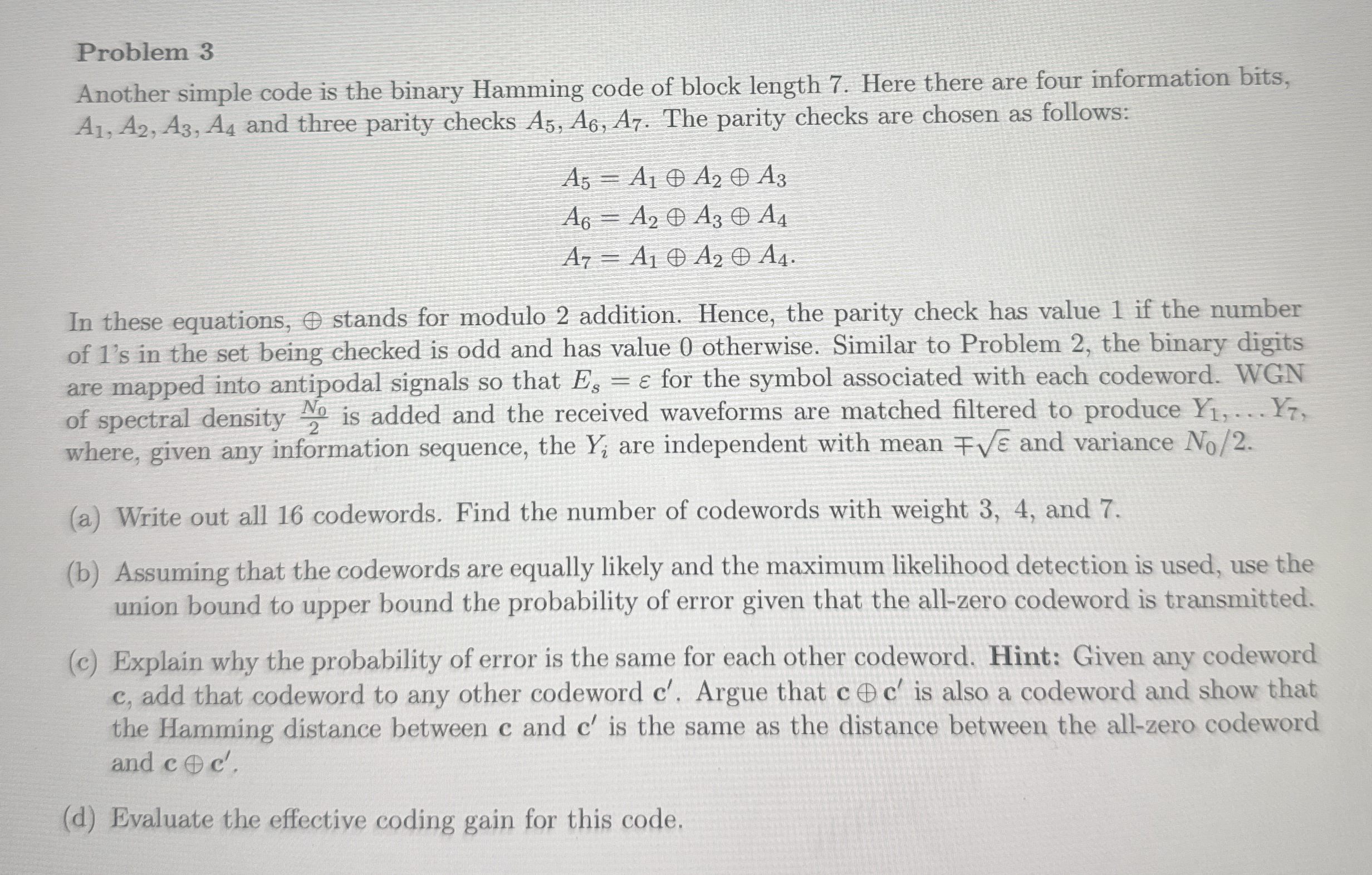
Another simple code is the binary Hamming code of block length Here there are four information bits, and three parity checks The parity checks are chosen as follows:
In these equations, stands for modulo addition. Hence, the parity check has value if the number of s in the set being checked is odd and has value otherwise. Similar to Problem the binary digits are mapped into antipodal signals so that for the symbol associated with each codeword. WGN of spectral density is added and the received waveforms are matched filtered to produce where, given any information sequence, the are independent with mean and variance
a Write out all codewords. Find the number of codewords with weight and
b Assuming that the codewords are equally likely and the maximum likelihood detection is used, use the union bound to upper bound the probability of error given that the allzero codeword is transmitted.
c Explain why the probability of error is the same for each other codeword. Hint: Given any codeword add that codeword to any other codeword Argue that is also a codeword and show that the Hamming distance between and is the same as the distance between the allzero codeword and
d Evaluate the effective coding gain for this code.
Step by Step Solution
There are 3 Steps involved in it
1 Expert Approved Answer
Step: 1 Unlock

Question Has Been Solved by an Expert!
Get step-by-step solutions from verified subject matter experts
Step: 2 Unlock
Step: 3 Unlock
 Study Help