







Question: Problem 3 Consider a database with a Table A(x) containing integers. Adam runs a query (that is a transaction): Select sum(x) from A; Commit; Brandon
Problem 3 Consider a database with a Table A(x) containing integers. Adam runs a query (that is a transaction): Select sum(x) from A; Commit; Brandon consider a sequence of inserts (this is also a transaction): Insert into A values (10); Insert into A values (20); Insert into A values (30); Commit; Christopher consider a sequence of deletes (this is also a transaction): Delete from A where x=30; Delete from A where x=20; Commit; At the beginning, before executing any transaction, the sum of the integers in A is 1000 and none of them are 10, 20, or 30. If all transactions (under isolation level READ COMMITTED) ru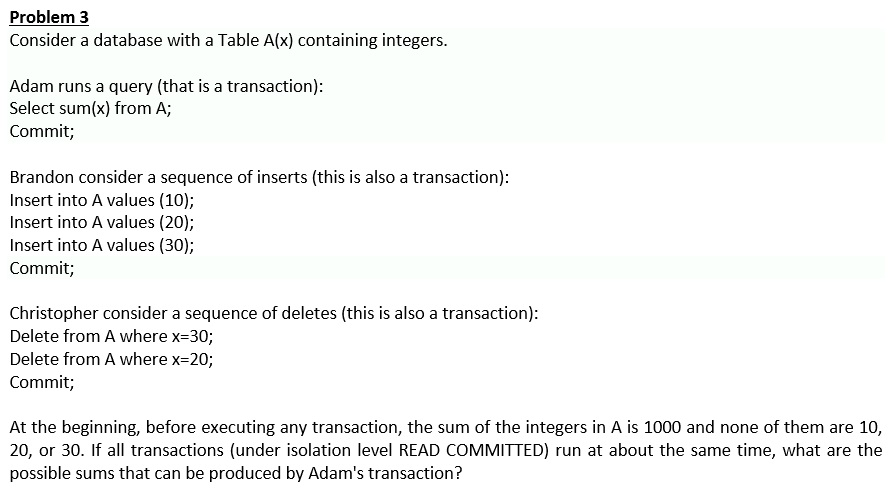 n at about the same time, what are the possible sums that can be produced by Adam's transaction?
Problem 3 Consider a database with a Table A(x) containing integers. Adam runs a query (that is a transaction): Select sum(x) from A; Commit; Brandon consider a sequence of inserts (this is also a transaction): Insert into A values (10); Insert into A values (20); Insert into A values (30) Commit; Christopher consider a sequence of deletes (this is also a transaction): Delete from A where x-30; Delete from A where x-20; Commit; At the beginning, before executing any transaction, the sum of the integers in A is 1000 and none of them are 10, 20, or 30. Ifall ransactions (under isolation level READ COMMITTED) run at about the same time, what are the possible sums that can be produced by Adam's transaction
Step by Step Solution
There are 3 Steps involved in it

Get step-by-step solutions from verified subject matter experts
 Study Help