







Question: Problem 3. Consider a Moore machine implementation of a pattern detector that outputs a 1 whenever it encounters two consecutive Os, or two consecutive 1s,
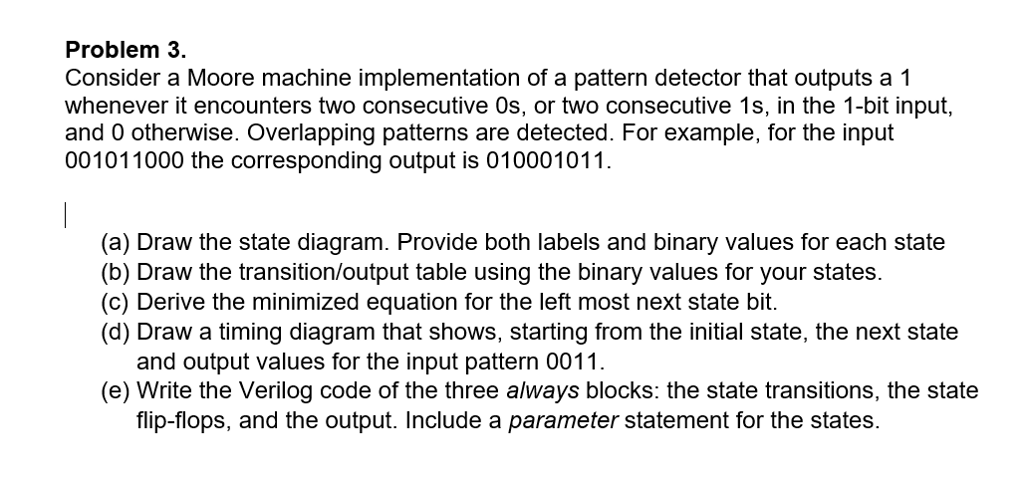
Problem 3. Consider a Moore machine implementation of a pattern detector that outputs a 1 whenever it encounters two consecutive Os, or two consecutive 1s, in the 1-bit input, and 0 otherwise. Overlapping patterns are detected. For example, for the input 001011000 the corresponding output is 010001011 (a) Draw the state diagram. Provide both labels and binary values for each state (b) Draw the transition/output table using the binary values for your states. (c) Derive the minimized equation for the left most next state bit. (d) Draw a timing diagram that shows, starting from the initial state, the next state and output values for the input pattern 0011. (e) Write the Verilog code of the three always blocks: the state transitions, the state flip-flops, and the output. Include a parameter statement for the states. Problem 3. Consider a Moore machine implementation of a pattern detector that outputs a 1 whenever it encounters two consecutive Os, or two consecutive 1s, in the 1-bit input, and 0 otherwise. Overlapping patterns are detected. For example, for the input 001011000 the corresponding output is 010001011 (a) Draw the state diagram. Provide both labels and binary values for each state (b) Draw the transition/output table using the binary values for your states. (c) Derive the minimized equation for the left most next state bit. (d) Draw a timing diagram that shows, starting from the initial state, the next state and output values for the input pattern 0011. (e) Write the Verilog code of the three always blocks: the state transitions, the state flip-flops, and the output. Include a parameter statement for the states
Step by Step Solution
There are 3 Steps involved in it

Get step-by-step solutions from verified subject matter experts
 Study Help