







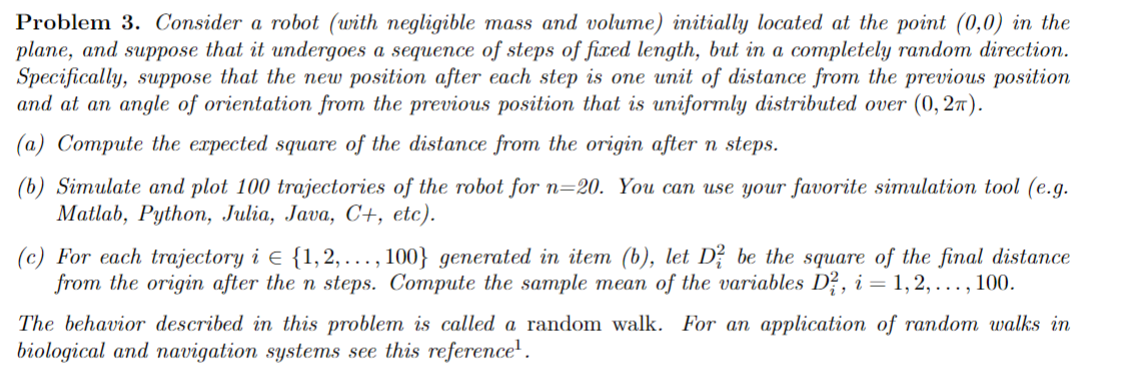
Question: Problem 3 . Consider a robot ( with negligible mass and volume ) initially located at the point ( 0 , 0 ) in the
Problem Consider a robot with negligible mass and volume initially located at the point in the
plane, and suppose that it undergoes a sequence of steps of fixed length, but in a completely random direction.
Specifically, suppose that the new position after each step is one unit of distance from the previous position
and at an angle of orientation from the previous position that is uniformly distributed over
a Compute the expected square of the distance from the origin after steps.
b Simulate and plot trajectories of the robot for n You can use your favorite simulation tool eg
Matlab, Python, Julia, Java, C etc
c For each trajectory iindots, generated in item b let be the square of the final distance
from the origin after the steps. Compute the sample mean of the variables dots,
The behavior described in this problem is called a random walk. For an application of random walks in
biological and navigation systems see this reference
Step by Step Solution
There are 3 Steps involved in it
1 Expert Approved Answer
Step: 1 Unlock

Question Has Been Solved by an Expert!
Get step-by-step solutions from verified subject matter experts
Step: 2 Unlock
Step: 3 Unlock
 Study Help