







Question: Problem 3 Consider a simple enzymatic reaction running in a perfectly mixed batch bioreactor in the presence of soluble biocatalyst undergoing inactivation. Substrate mimoduct Prod
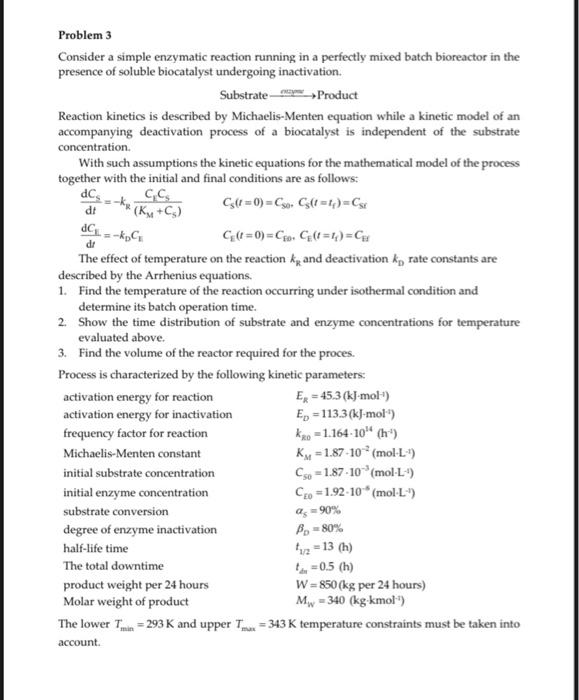
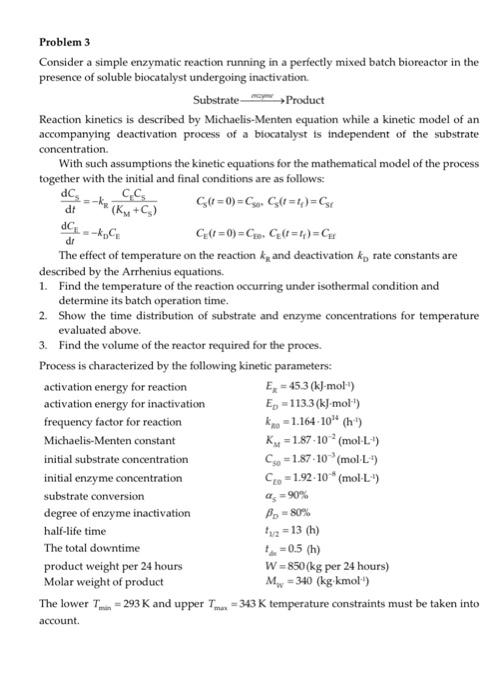
Problem 3 Consider a simple enzymatic reaction running in a perfectly mixed batch bioreactor in the presence of soluble biocatalyst undergoing inactivation. Substrate mimoduct Prod Reaction kinetics is described by Michaelis-Menten equation while a kinetic model of an accompanying deactivation process of a biocatalyst is independent of the substrate concentration. With such assumptions the kinetic equations for the mathematical model of the process together with the initial and final conditions are as follows: dtdCS=kE(KM+CS)CLCSdtdC1=kDCKCS(t=0)=CSo,CS(t=tf)=CStCE(t=0)=CE0,CE(t=tf)=CB The effect of temperature on the reaction kk and deactivation kD rate constants are described by the Arrhenius equations. 1. Find the temperature of the reaction occurring under isothermal condition and determine its batch operation time. 2. Show the time distribution of substrate and enzyme concentrations for temperature evaluated above. 3. Find the volume of the reactor required for the proces. Process is characterized by the following kinetic parameters: The lower Tmin=293K and upper Tmin=343K temperature constraints must be taken into account. Problem 3 Consider a simple enzymatic reaction running in a perfectly mixed batch bioreactor in the presence of soluble biocatalyst undergoing inactivation. Substrate Product Reaction kinetics is described by Michaelis-Menten equation while a kinetic model of an accompanying deactivation process of a biocatalyst is independent of the substrate concentration. With such assumptions the kinetic equations for the mathematical model of the process together with the initial and final conditions are as follows: dtdC5=kE(KM+CS)CEC5dtdCE=kDCECs(t=0)=CSo,Cs(t=tf)=CStCE(t=0)=CED,CE(t=tt)=CEr The effect of temperature on the reaction km and deactivation kD rate constants are described by the Arrhenius equations. 1. Find the temperature of the reaction occurring under isothermal condition and determine its batch operation time. 2. Show the time distribution of substrate and enzyme concentrations for temperature evaluated above. 3. Find the volume of the reactor required for the proces. Pronoce ic charartarived her tha follonuina himatio maramatare- The lower Tmin=293K and upper Tmax=343K temperature constraints must be taken into account
Step by Step Solution
There are 3 Steps involved in it

Get step-by-step solutions from verified subject matter experts
 Study Help