







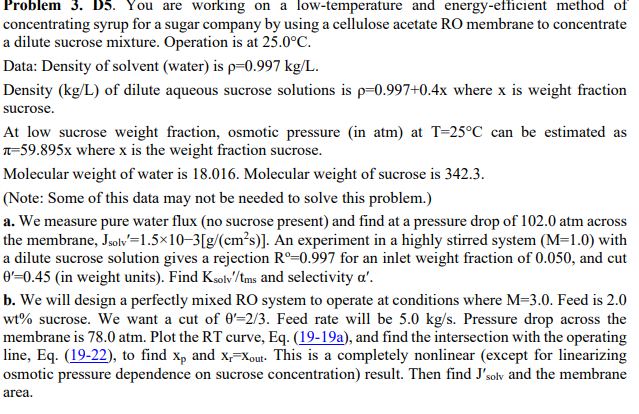
Question: Problem 3 . D 5 . You are working on a low - temperature and energy - efficient method of concentrating syrup for a sugar
Problem D You are working on a lowtemperature and energyefficient method of
concentrating syrup for a sugar company by using a cellulose acetate RO membrane to concentrate
a dilute sucrose mixture. Operation is at
Data: Density of solvent water is
Density of dilute aqueous sucrose solutions is where is weight fraction
sucrose.
At low sucrose weight fraction, osmotic pressure in atm at can be estimated as
where is the weight fraction sucrose.
Molecular weight of water is Molecular weight of sucrose is
Note: Some of this data may not be needed to solve this problem.
a We measure pure water flux no sucrose present and find at a pressure drop of atm across
the membrane, An experiment in a highly stirred system with
a dilute sucrose solution gives a rejection for an inlet weight fraction of and cut
in weight units Find and selectivity
b We will design a perfectly mixed RO system to operate at conditions where Feed is
wt sucrose. We want a cut of Feed rate will be Pressure drop across the
membrane is atm. Plot the RT curve, Eqa and find the intersection with the operating
line, Eq to find and This is a completely nonlinear except for linearizing
osmotic pressure dependence on sucrose concentration result. Then find and the membrane
area.
Step by Step Solution
There are 3 Steps involved in it
1 Expert Approved Answer
Step: 1 Unlock

Question Has Been Solved by an Expert!
Get step-by-step solutions from verified subject matter experts
Step: 2 Unlock
Step: 3 Unlock
 Study Help