







Question: Problem 3: Disk of Charge and Limiting Cases Consider a very thin disk of radius R, with a uniformly-distributed charge Q. We can show that,
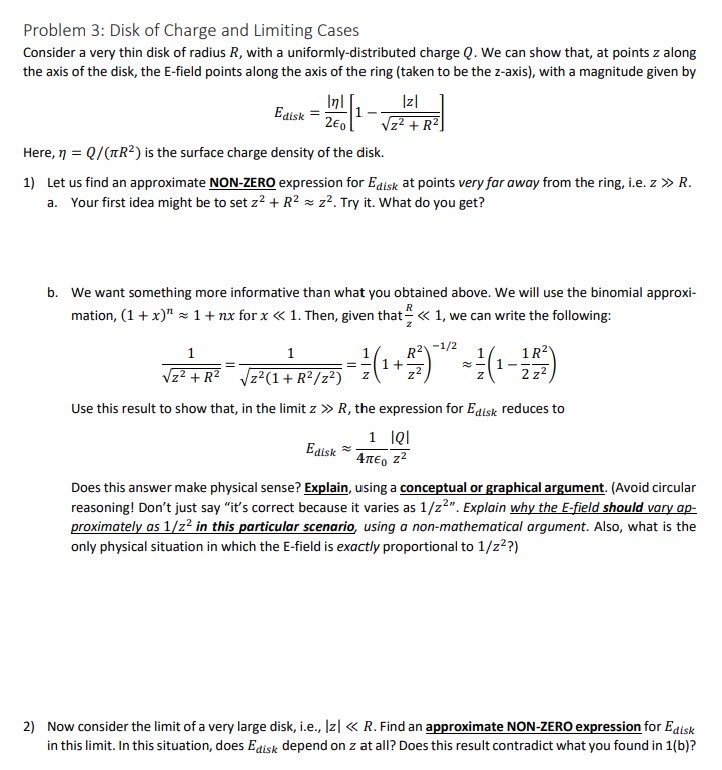
Problem 3: Disk of Charge and Limiting Cases Consider a very thin disk of radius R, with a uniformly-distributed charge Q. We can show that, at points z along the axis of the disk, the E-field points along the axis of the ring (taken to be the z-axis), with a magnitude given by Edisk = In! [ ZEO Vz2 + R2 Here, n = Q/(R) is the surface charge density of the disk. 1) Let us find an approximate NON-ZERO expression for Edisk at points very far away from the ring, i.e. z >> R. a. Your first idea might be to set z2 + R2 = z2. Try it. What do you get? b. We want something more informative than what you obtained above. We will use the binomial approxi- mation, (1 + x)" = 1 + nx for x > R, the expression for Edisk reduces to 1 1Q1 Edisk AREQ Z2 Does this answer make physical sense? Explain, using a conceptual or graphical argument. (Avoid circular reasoning! Don't just say "it's correct because it varies as 1/z"". Explain why the E-field should vary ap- proximately as 1/zz in this particular scenario, using a non-mathematical argument. Also, what is the only physical situation in which the E-field is exactly proportional to 1/zz?) 2) Now consider the limit of a very large disk, i.e., Iz|
Step by Step Solution
There are 3 Steps involved in it

Get step-by-step solutions from verified subject matter experts
 Study Help