







Question: Problem 3: (ER Modeling) (30 Points Consider the following Requirements for developing Banking Entr - The bank is organized into branches. Each eity and is
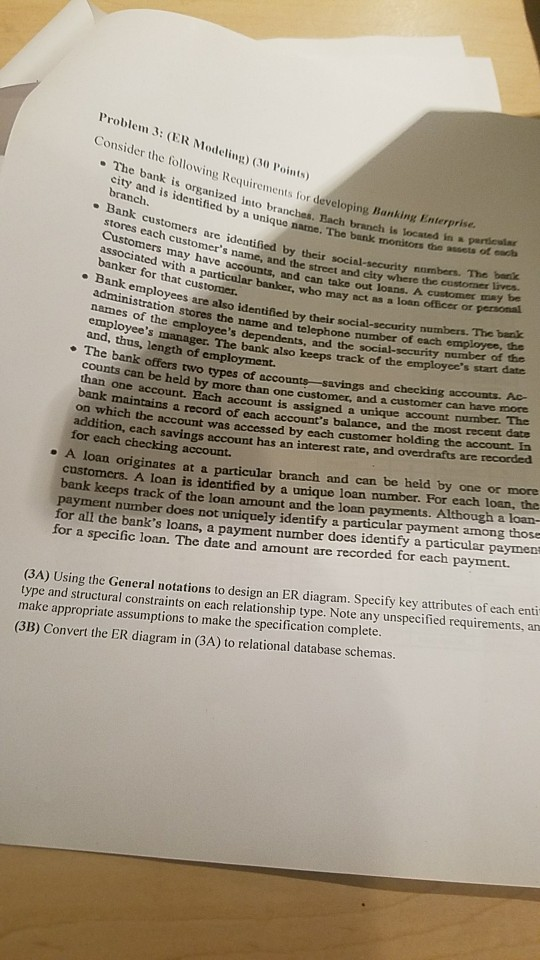
Problem 3: (ER Modeling) (30 Points Consider the following Requirements for developing Banking Entr - The bank is organized into branches. Each eity and is identified by a unique natme. branch. branch is located in a particular The bank monitors dhe as stores each customer's name, mers are identified by their social-security nombers. Customers may have accounts, and can take out loans. A euicer or perional associated with a particular bankker, who may nct as a banker for that customer. and the street and city where the customer lives. loan officer or . Bank employees are also identified by their social-security numbers. The bank names of the employee's employee's and, thus, length of employment. name and telephone number of each employee, the s dependents, and the social-security number of the manager. The bank also keeps track of the employee's start date can be held by more than one customer, and a customer can have more one account. Each account is assigned a unique account number. The two types of accounts- savings and checking accounts. Ac counts bank maintains a record of each account's balance, and the most recent date on which the account was accessed by each customer holding the account. In addi for each checking account. tion, each savings account has an interest rate, and overdrafts are recorded customers. A loan is identified by a unique loan number. For each loan, the bank keeps track of the loan amount and the loan payments. Although a loan- payment number does not uniquely identify a particular payment among for all the bank's loans, a payment number does identify a particular payment for a specific loan. The date and amount are recorded for each payment. - A loan originates at a particular branch and can be held by one or more (3A) Using the General notations to design an ER diagram. Specify key attributes of each enti type and structural constraints on each relationship type. Note any unspecified requirements, an make appropriate assumptions to make the specification complete (3B) Convert the ER diagram in (3A) to relational database schemas
Step by Step Solution
There are 3 Steps involved in it

Get step-by-step solutions from verified subject matter experts
 Study Help