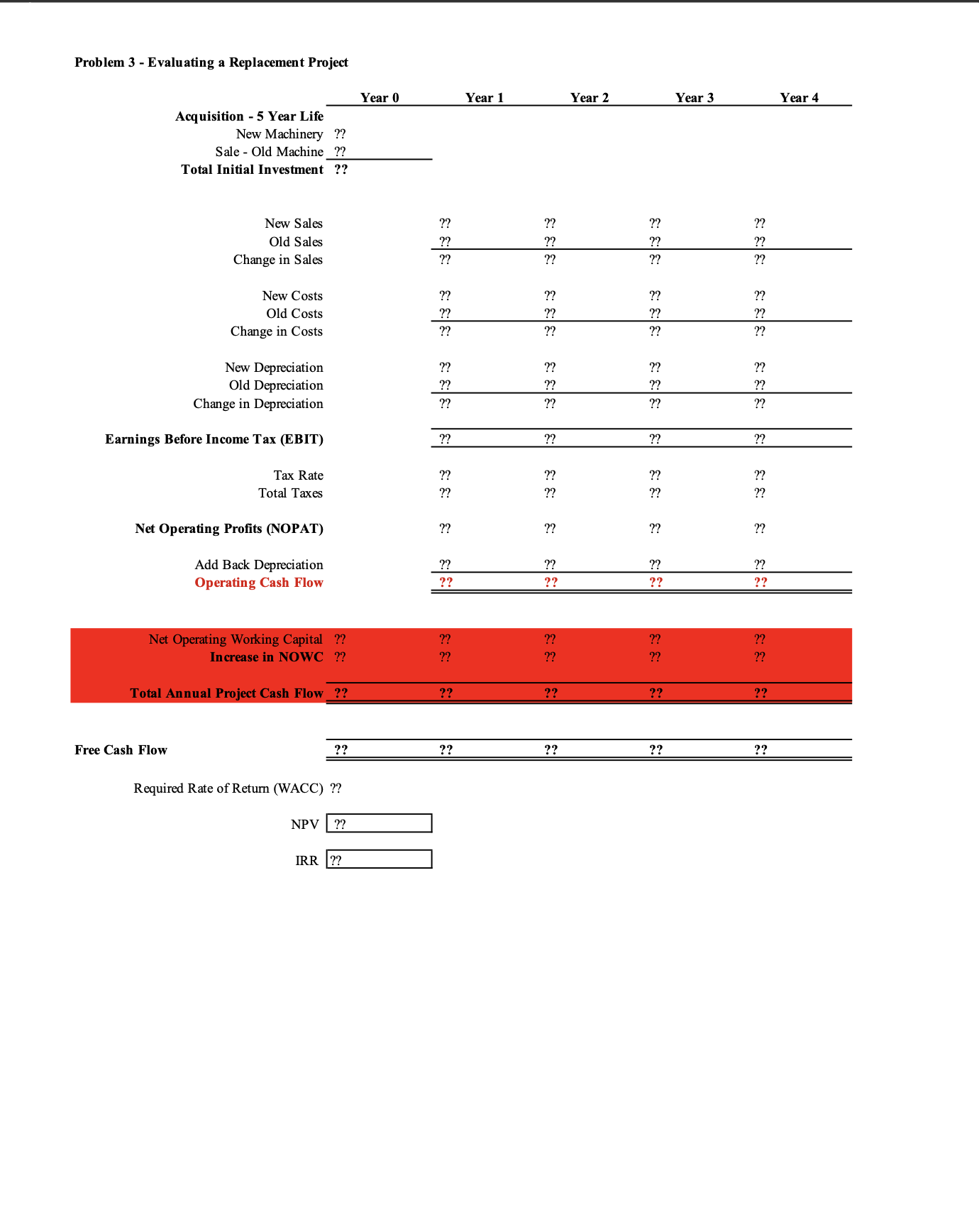
Question: Problem 3 - Evaluating a Replacement Project Year 0 Year 1 Year 2 Year 3 Year 4 Acquisition - 5 Year Life New Machinery ??
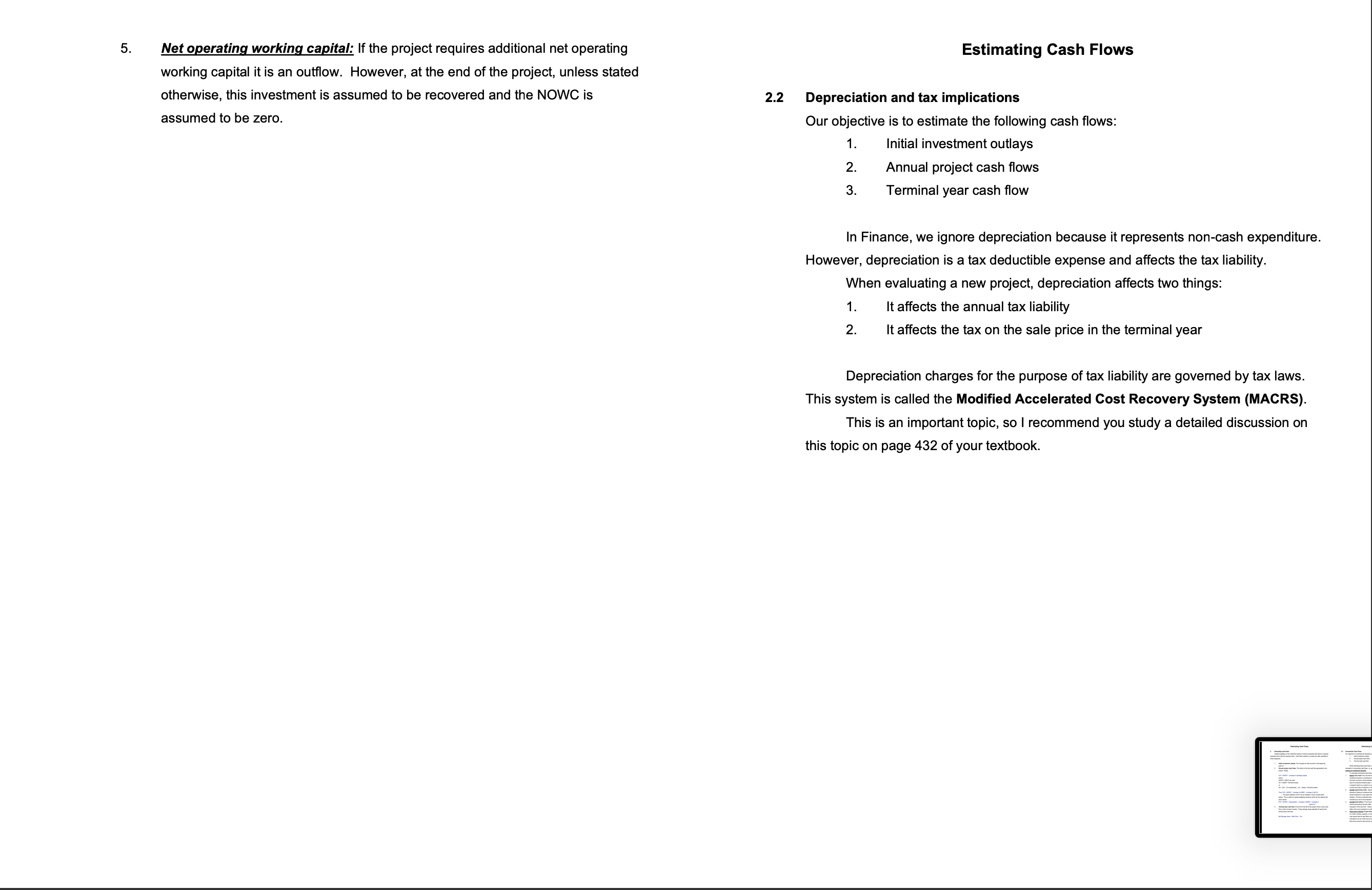
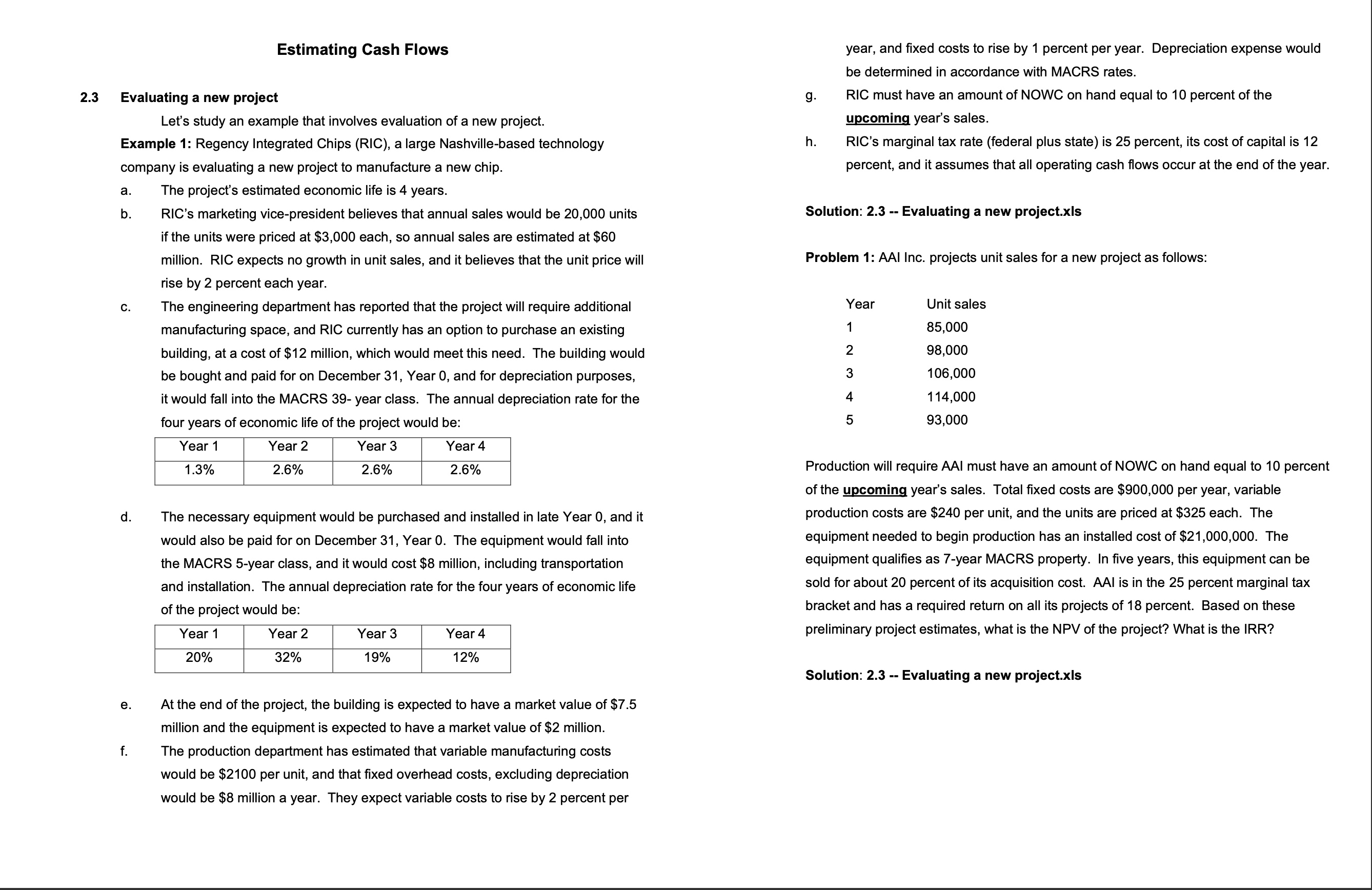
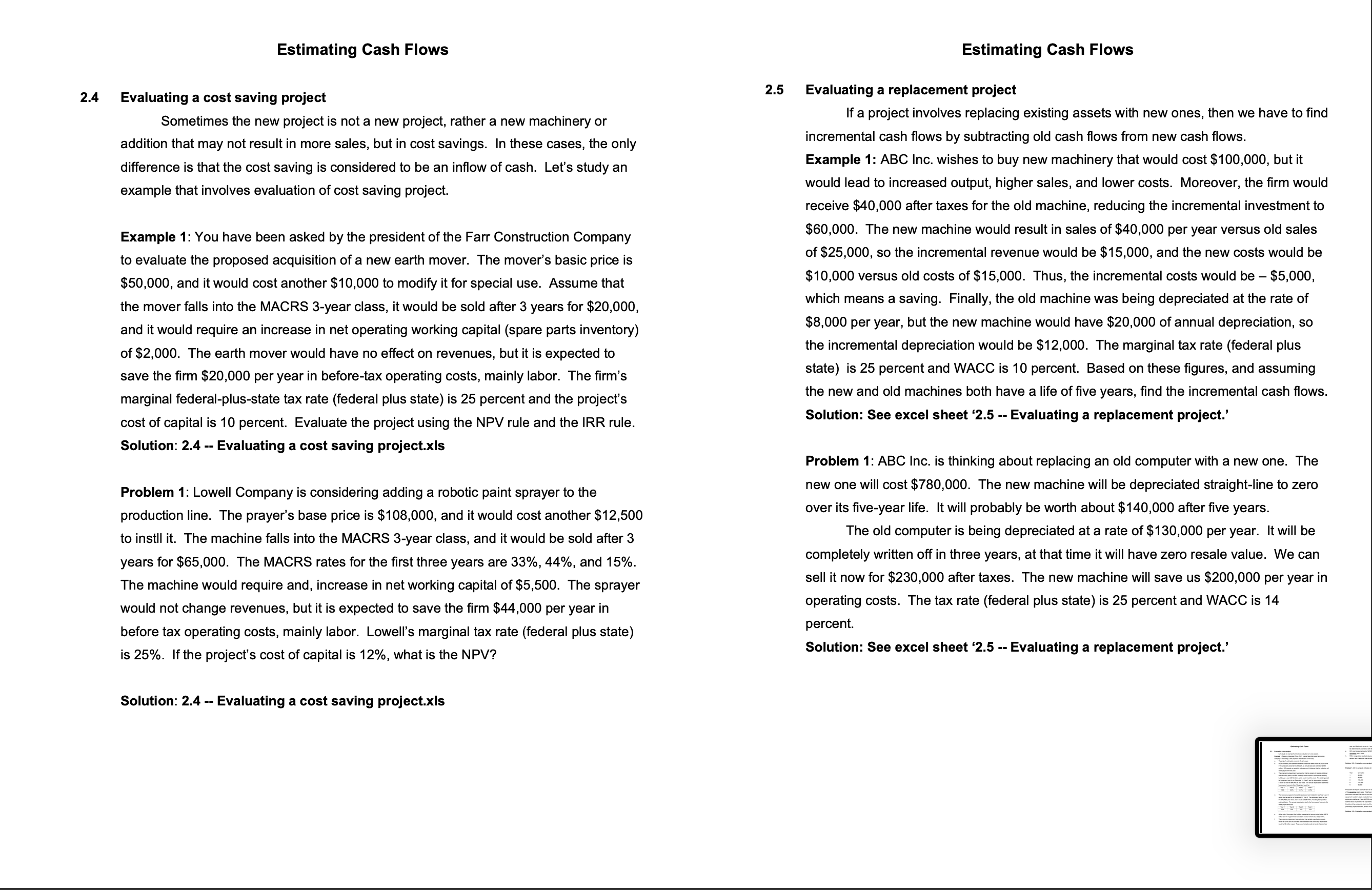
Problem 3 - Evaluating a Replacement Project Year 0 Year 1 Year 2 Year 3 Year 4 Acquisition - 5 Year Life New Machinery ?? Sale - Old Machine ?? Total Initial Investment ?? New Sales Old Sales Change in Sales New Costs Old Costs Change in Cost New Depreciation Old Depreciation Change in Depreciation Earnings Before Income Tax (EBIT) ? ? 2? Tax Rate ? ? Total Taxes Net Operating Profits (NOPAT) ? ? Add Back Depreciation Operating Cash Flow ? ? 2? Net Operating Working Capital ?? ? ? ?? Increase in NOWC ?? 22 Total Annual Project Cash Flow ?? ?? ?? ?? ?? Free Cash Flow ?? ?? ?? ?? ?? Required Rate of Return (WACC) ?? NPV ?? IRR ??Net ogerating working capital: If the project requires additional net operating working capital it is an outow. However, at the end of the project, unless stated othenNise, this investment is assumed to be recovered and the NOWC is assumed to be zero. 2.2 Estimating Cash Flows Depreciation and tax implications Our objective is to estimate the following cash flows: 1. Initial investment outlays 2. Annual project cash ows 3. Terminal year cash ow In Finance, we ignore depreciation because it represents non-cash expenditure. However, depreciation is a tax deductible expense and affects the tax liability. When evaluating a new project, depreciation affects two things: 1. It affects the annual tax liability 2. It affects the tax on the sale price in the terminal year Depreciation charges for the purpose of tax liability are governed by tax laws. This system is called the Modified Accelerated Cost Recovery System (MACRS). This is an important topic, so I recommend you study a detailed discussion on this topic on page 432 of your textbook. 2.3 Estimating Cash Flows Evaluating a new project Let's study an example that involves evaluation of a new project. Example 1: Regency Integrated Chips (RIC), a large Nashville-based technology company is evaluating a new project to manufacture a new chip. a. The project's estimated economic life is 4 years. b. RIC's marketing vice-president believes that annual sales would be 20,000 units if the units were priced at $3,000 each. so annual sales are estimated at $60 million. RIC expects no growth in unit sales, and it believes that the unit price will rise by 2 percent each year. c. The engineering department has reported that the project will require additional manufacturing space, and RIC currently has an option to purchase an existing building, at a cost of $12 million, which would meet this need. The building would be bought and paid for on December 31, Year 0, and for depreciation purposes, it would fall into the MACRS 39- year class. The annual depreciation rate for the four years of economic life of the project would be: Year 1 Year 2 Year 3 Year 4 1.3% 2.6% 2.6% 2.6% d. The necessary equipment would be purchased and installed in late Year 0, and it would also be paid for on December 31, Year 0. The equipment would fall into the MACRS 5-year class, and it would cost $8 million, including transportation and installation. The annual depreciation rate for the four years of economic life of the project would be: Year 1 Year 2 Year 3 Year 4 20% 32% 19% 12% e. At the end of the project, the building is expected to have a market value of $7.5 million and the equipment is expected to have a market value of $2 million. f. The production department has estimated that variable manufacturing costs would be $2100 per unit, and that xed overhead costs, excluding depreciation would be $8 million a year. They expect variable costs to rise by 2 percent per year, and xed costs to rise by 1 percent per year. Depreciation expense would be determined in accordance with MACRS rates. 9. RIC must have an amount of NOWC on hand equal to 10 percent of the ugoming years sales. h. RIC's marginal tax rate (federal plus state) is 25 percent, its cost of capital is 12 percent, and it assumes that all operating cash ows occur at the end of the year. Solution: 2.3 -- Evaluating a new project.xls Problem 1: AAI Inc. projects unit sales for a new project as follows: Year Unit sales 1 85,000 2 98,000 3 106,000 4 114,000 5 93,000 Production will require AAI must have an amount of NOWC on hand equal to 10 percent of the ugming year's sales. Total xed costs are $900,000 per year, variable production costs are $240 per unit, and the units are priced at $325 each. The equipment needed to begin production has an installed cost of $21 ,000,000. The equipment qualies as 7-year MACRS property. In ve years, this equipment can be sold for about 20 percent of its acquisition cost. AAI is in the 25 percent marginal tax bracket and has a required return on all its projects of 18 percent. Based on these preliminary project estimates, what is the NPV of the project? What is the IRR? Solution: 2.3 -- Evaluating a new project.xls 2.4 Estimating Cash Flows Evaluating a cost saving project Sometimes the new project is not a new project, rather a new machinery or addition that may not result in more sales, but in cost savings. In these cases, the only difference is that the cost saving is considered to be an inow of cash. Let's study an example that involves evaluation of cost saving project. Example 1: You have been asked by the president of the Farr Construction Company to evaluate the proposed acquisition of a new earth mover. The movers basic price is $50,000, and it would cost another $10,000 to modify it for special use. Assume that the mover falls into the MACRS 3-year class, it would be sold after 3 years for $20,000, and it would require an increase in net operating working capital (spare parts inventory) of $2,000. The earth mover would have no effect on revenues, but it is expected to save the rm $20,000 per year in beforetax operating costs, mainly labor. The rm's marginal federal-plus-state tax rate (federal plus state) is 25 percent and the project's cost of capital is 10 percent. Evaluate the project using the NPV rule and the IRR rule. Solution: 2.4 -- Evaluating a cost saving project.xls Problem 1: Lowell Company is considering adding a robotic paint sprayer to the production line. The prayer's base price is $108,000, and it would cost another $12,500 to instll it. The machine falls into the MACRS 3-year class, and it would be sold after 3 years for $65,000. The MACRS rates for the rst three years are 33%, 44%, and 15%. The machine would require and, increase in net working capital of $5,500. The sprayer would not change revenues, but it is expected to save the rm $44,000 per year in before tax operating costs, mainly labor. Lowell's marginal tax rate (federal plus state) is 25%. If the project's cost of capital is 12%, what is the NPV? Solution: 2.4 -- Evaluating a cost saving project.xls 2.5 Estimating Cash Flows Evaluating a replacement project If a project involves replacing existing assets with new ones, then we have to nd incremental cash ows by subtracting old cash ows from new cash ows. Example 1: ABC Inc. wishes to buy new machinery that would cost $100,000, but it would lead to increased output, higher sales, and lower costs. Moreover, the rm would receive $40,000 after taxes for the old machine, reducing the incremental investment to $60,000. The new machine would result in sales of $40,000 per year versus old sales of $25,000, so the incremental revenue would be $15,000, and the new costs would be $10,000 versus old costs of $15,000. Thus, the incremental costs would be $5,000, which means a saving. Finally, the old machine was being depreciated at the rate of $8,000 per year, but the new machine would have $20,000 of annual depreciation, so the incremental depreciation would be $12,000. The marginal tax rate (federal plus state) is 25 percent and WACC is 10 percent. Based on these gures, and assuming the new and old machines both have a life of ve years, nd the incremental cash ows. Solution: See excel sheet '25 -- Evaluating a replacement project! Problem 1: ABC Inc. is thinking about replacing an old computer with a new one. The new one will cost $780,000. The new machine will be depreciated straight-line to zero over its ve-year life. It will probably be worth about $140,000 after ve years. The old computer is being depreciated at a rate of $130,000 per year. It will be completely written off in three years, at that time it will have zero resale value. We can sell it now for $230,000 aer taxes. The new machine will save us $200,000 per year in operating costs. The tax rate (federal plus state) is 25 percent and WACC is 14 percent. Solution: See excel sheet '2.5 -- Evaluating a replacement project
Step by Step Solution
There are 3 Steps involved in it
1 Expert Approved Answer
Step: 1 Unlock
Question Has Been Solved by an Expert!
Get step-by-step solutions from verified subject matter experts
Step: 2 Unlock
Step: 3 Unlock
Students Have Also Explored These Related Accounting Questions!









 Study Help