



Question: Problem: 3. (Exercise Lecture 28) Determine the Laplace transform of each function using properties discussed in Lecture 28. f(t) = t2 sin (wt) f(t) =
Problem:

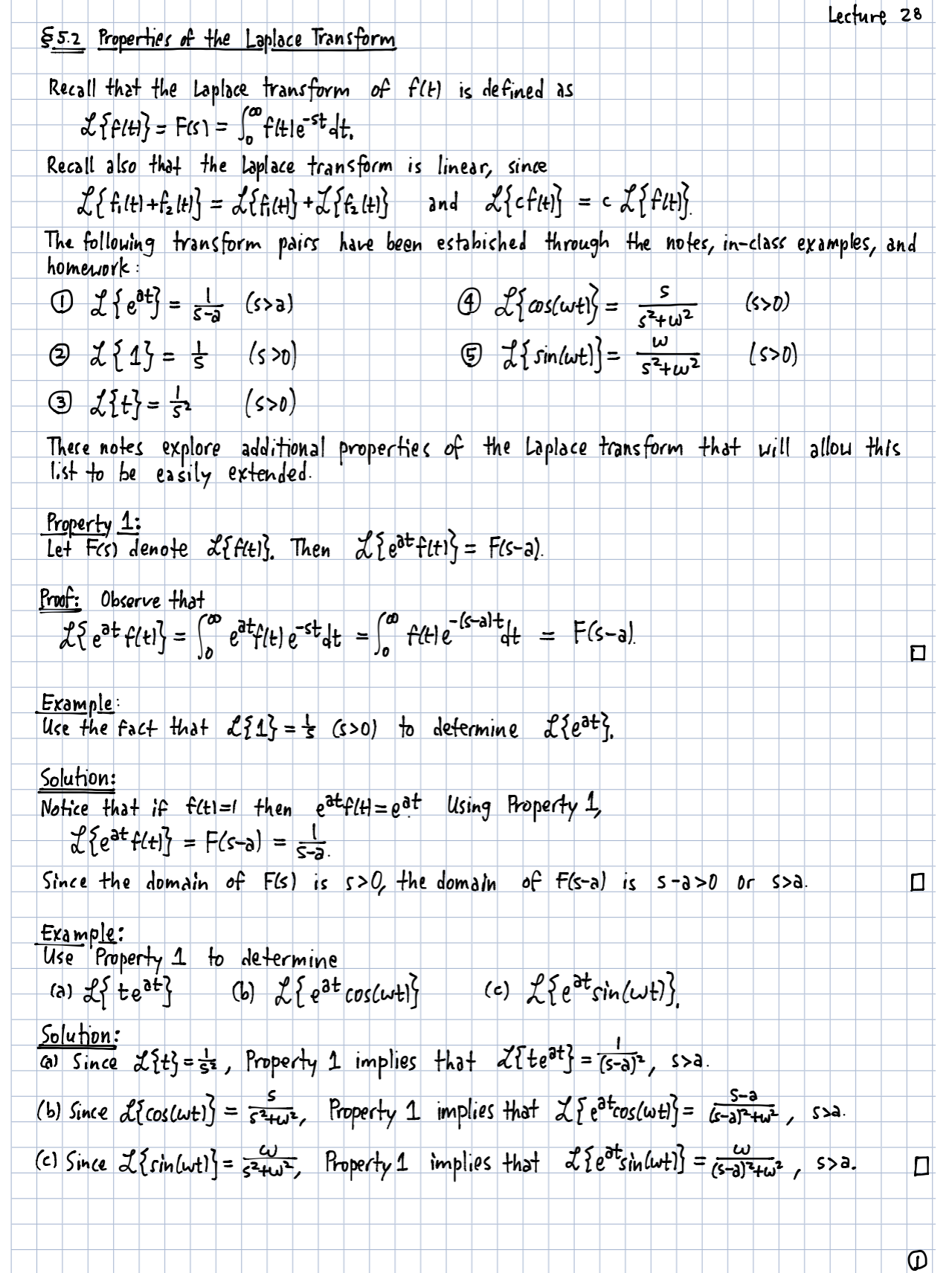
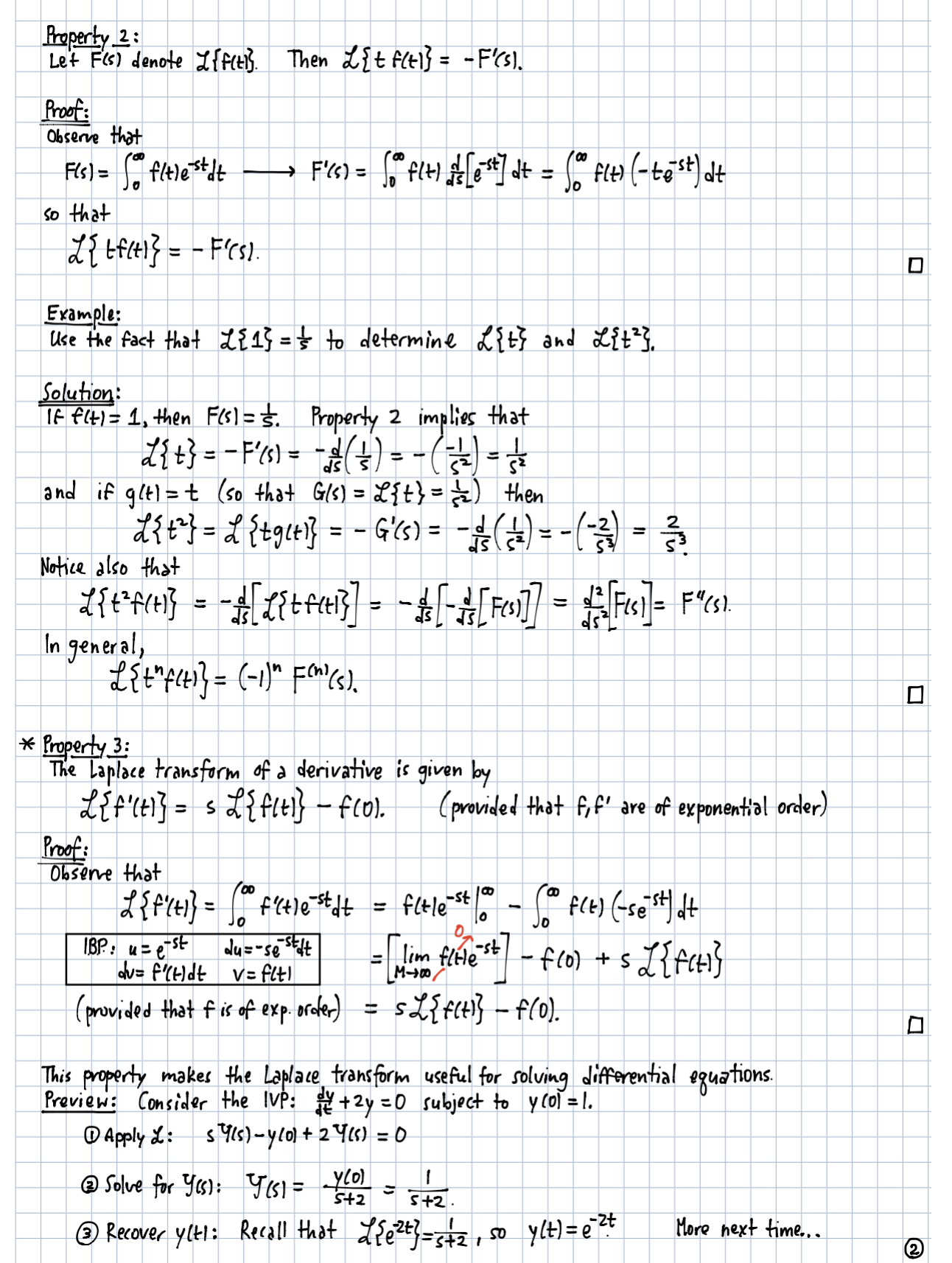
3. (Exercise Lecture 28) Determine the Laplace transform of each function using properties discussed in Lecture 28. f(t) = t2 sin (wt) f(t) = t6e5* + t4 f ) a. b. c. (t =tegtcos(3t) Lecture 28 $5.2 Properties of the Laplace Transform Recall that the Laplace transform of f(t) is defined as 2 {ACH ] = FISI = Jo fitlest It. Recall also that the Laplace transform is linear, since The following transform pairs have been estabished through the notes, in-class examples, and homework : D d fest] = (s>a) A Lcostwith = S 52 + W 2 ( 5> 0 ) 2 2{1} = 5 (5>0) 2 { sin(wtl) = w 5 2 + w 2 ( 5>0 ) ( s>o ) There notes explore additional properties of the Laplace transform that will allow this list to be easily extended. Property 1: Let FCS) denote Lifitis. Then Lieatfitly = F(s-2). Proof: Observe that (feat f(ti] = eatfitlestat = @ fitlesalty at = F (s-a). Example: Use the fact that 291} = * ( s>0 ) to determine death . Solution: Notice that if fitl=1 then eatf(H = gat Using Property 1, (feat Altl] = F(s-a) = 5-a. Since the domain of F(s ) is s>0 , the domain of F (s-a ) is 5-a>0 or s> d . 0 Example: Use Property 1 to determine (a) &i teat? (6) 2{ eat cosletly (c ) Letsin ( we)). Solution: (a) Since Lith = ss , Property 1 implies that Ziteat} = (s-ajz, s>a ( b ) Since dicos( wt] ) = sarwe, Property 1 implies that Li eatcos( with) = (s-artu , sta. ( c) Since Lisin(well = szcz, Property 1 implies that die sinceAll = (5- arztus, s>a.Property 2 : Let F (S) denote Lif(tis. Then Lit f(+1) = - F'(s). Proof: Observe that F(s ) = [ fitlestat > F (s ) = So" fitI f's lest ] at = Soo fit) (- test) at so that 2{ Ef(tis = - F'es). Example: Use the fact that LEIS = 5 to determine Let's and Litz ]. Solution: IF fit ) = 1, then F(S) = 3. Property 2 implies that and if q(+1 = t ( so that G/s) = 2 {t ) = ) then { { tz ] = { {tgit) = - G'(s) = - $ (4)= -13=3 Notice also that Zit f(+13 - - $3 [ eftf(13 ] - - $'s [ is [ Fes)] = 1, Fish] = F " (s). In general, Let"fitin = (-1)" FCWi (S). 0 * Property 3: The Laplace transform of a derivative is given by 2{filth ] = $ 2{fits - flo). ( provided that fif' are of exponential order) Proof: Observe that {{FYHI) = fitle stat = fitle- st - " f(+) ( -sest ) at IBP : u= est du = - se stat du = f'(+ ldt v=fit ! Him fitle st - flo ) + $ LifCtis ( provided that f is of exp order) = s Lif(ti} - f(0). This property makes the Laplace transform useful for solving differential equations . Preview: Consider the IVP: + 2y =0 subject to y co) = 1. @ Apply d: syls) - 410) + 2 4(S) = 0 2 Solve for Yes): J(S) = yLOL 5+2 5+2 3 Recover y( +1: Recall that drezty =+, , so y (t) = ezt More next time... 2
Step by Step Solution
There are 3 Steps involved in it

Get step-by-step solutions from verified subject matter experts