







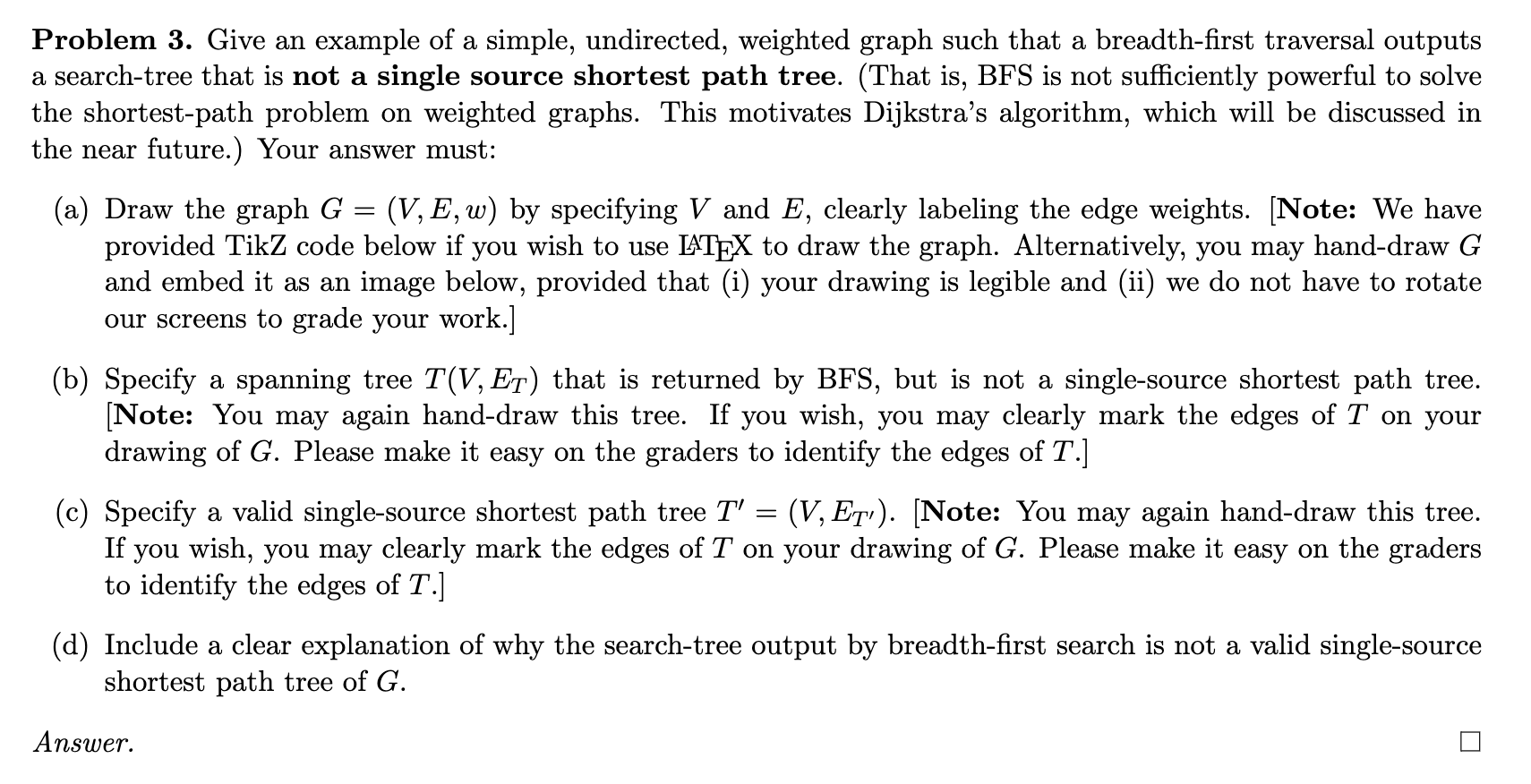
Question: Problem 3 . Give an example of a simple, undirected, weighted graph such that a breadth - first traversal outputs a search - tree that
Problem Give an example of a simple, undirected, weighted graph such that a breadthfirst traversal outputs
a searchtree that is not a single source shortest path tree. That is BFS is not sufficiently powerful to solve
the shortestpath problem on weighted graphs. This motivates Dijkstra's algorithm, which will be discussed in
the near future. Your answer must:
a Draw the graph by specifying and clearly labeling the edge weights. Note: We have
provided TikZ code below if you wish to use to draw the graph. Alternatively, you may handdraw
and embed it as an image below, provided that i your drawing is legible and ii we do not have to rotate
our screens to grade your work.
b Specify a spanning tree that is returned by BFS but is not a singlesource shortest path tree.
Note: You may again handdraw this tree. If you wish, you may clearly mark the edges of on your
drawing of Please make it easy on the graders to identify the edges of
c Specify a valid singlesource shortest path tree Note: You may again handdraw this tree.
If you wish, you may clearly mark the edges of on your drawing of Please make it easy on the graders
to identify the edges of
d Include a clear explanation of why the searchtree output by breadthfirst search is not a valid singlesource
shortest path tree of
Answer.
Step by Step Solution
There are 3 Steps involved in it
1 Expert Approved Answer
Step: 1 Unlock

Question Has Been Solved by an Expert!
Get step-by-step solutions from verified subject matter experts
Step: 2 Unlock
Step: 3 Unlock
 Study Help