







Question: Problem 3 : In Example 1 5 . 1 in your textbook, we considered the laminar flow of a Newtonian fluid between two parallel plates
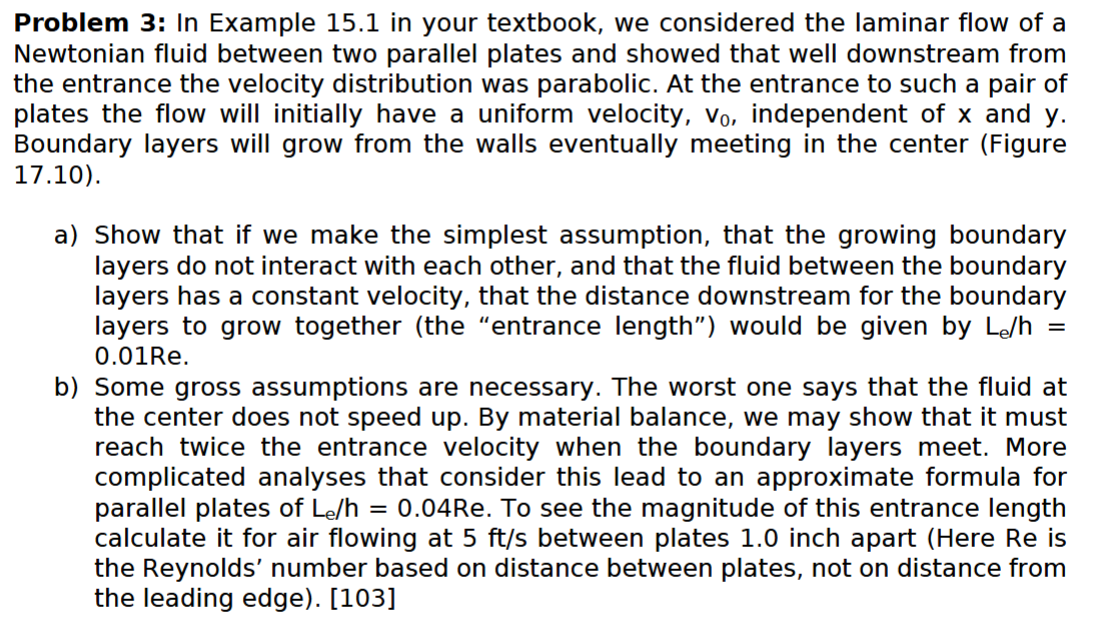
Problem : In Example in your textbook, we considered the laminar flow of a Newtonian fluid between two parallel plates and showed that well downstream from the entrance the velocity distribution was parabolic. At the entrance to such a pair of plates the flow will initially have a uniform velocity, v independent of x and y Boundary layers will grow from the walls eventually meeting in the center Figure
a Show that if we make the simplest assumption, that the growing boundary layers do not interact with each other, and that the fluid between the boundary layers has a constant velocity, that the distance downstream for the boundary layers to grow together the "entrance length" would be given by mathrmLmathrmemathrmh Re
b Some gross assumptions are necessary. The worst one says that the fluid at the center does not speed up By material balance, we may show that it must reach twice the entrance velocity when the boundary layers meet. More complicated analyses that consider this lead to an approximate formula for parallel plates of mathrmLmathrmemathrmhmathrmRe To see the magnitude of this entrance length calculate it for air flowing at mathrmftmathrms between plates inch apart Here Re is the Reynolds' number based on distance between plates, not on distance from the leading edge
Step by Step Solution
There are 3 Steps involved in it
1 Expert Approved Answer
Step: 1 Unlock

Question Has Been Solved by an Expert!
Get step-by-step solutions from verified subject matter experts
Step: 2 Unlock
Step: 3 Unlock
 Study Help