







Question: Problem 3 In medical applications, a common objective is to deliver the active pharmaceutical ingredient ( API ) to the target area and keep the
Problem
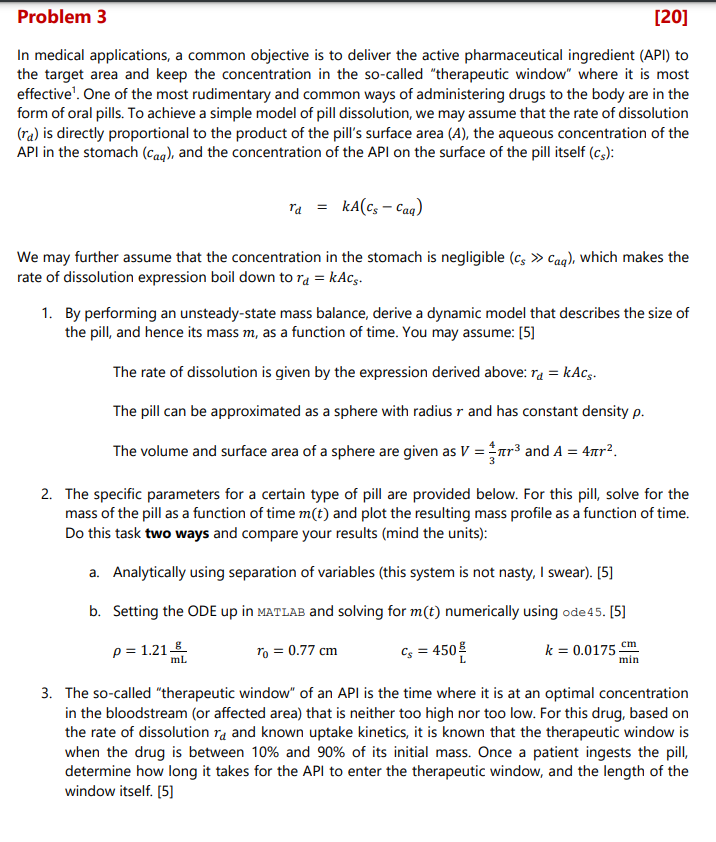
In medical applications, a common objective is to deliver the active pharmaceutical ingredient API to
the target area and keep the concentration in the socalled "therapeutic window" where it is most
effective One of the most rudimentary and common ways of administering drugs to the body are in the
form of oral pills. To achieve a simple model of pill dissolution, we may assume that the rate of dissolution
is directly proportional to the product of the pill's surface area the aqueous concentration of the
API in the stomach and the concentration of the API on the surface of the pill itself :
We may further assume that the concentration in the stomach is negligible which makes the
rate of dissolution expression boil down to
By performing an unsteadystate mass balance, derive a dynamic model that describes the size of
the pill, and hence its mass as a function of time. You may assume:
The rate of dissolution is given by the expression derived above:
The pill can be approximated as a sphere with radius and has constant density
The volume and surface area of a sphere are given as and
The specific parameters for a certain type of pill are provided below. For this pill, solve for the
mass of the pill as a function of time and plot the resulting mass profile as a function of time.
Do this task two ways and compare your results mind the units:
a Analytically using separation of variables this system is not nasty, I swear
b Setting the ODE up in MATLAB and solving for numerically using ode
The socalled "therapeutic window" of an API is the time where it is at an optimal concentration
in the bloodstream or affected area that is neither too high nor too low. For this drug, based on
the rate of dissolution and known uptake kinetics, it is known that the therapeutic window is
when the drug is between and of its initial mass. Once a patient ingests the pill,
determine how long it takes for the API to enter the therapeutic window, and the length of the
window itself.
Step by Step Solution
There are 3 Steps involved in it
1 Expert Approved Answer
Step: 1 Unlock

Question Has Been Solved by an Expert!
Get step-by-step solutions from verified subject matter experts
Step: 2 Unlock
Step: 3 Unlock
 Study Help