







Question: Problem 3 In the TCP protocol, a packet sent on a network is re-sent in case it goes lost (dropped). If the re-submission is also
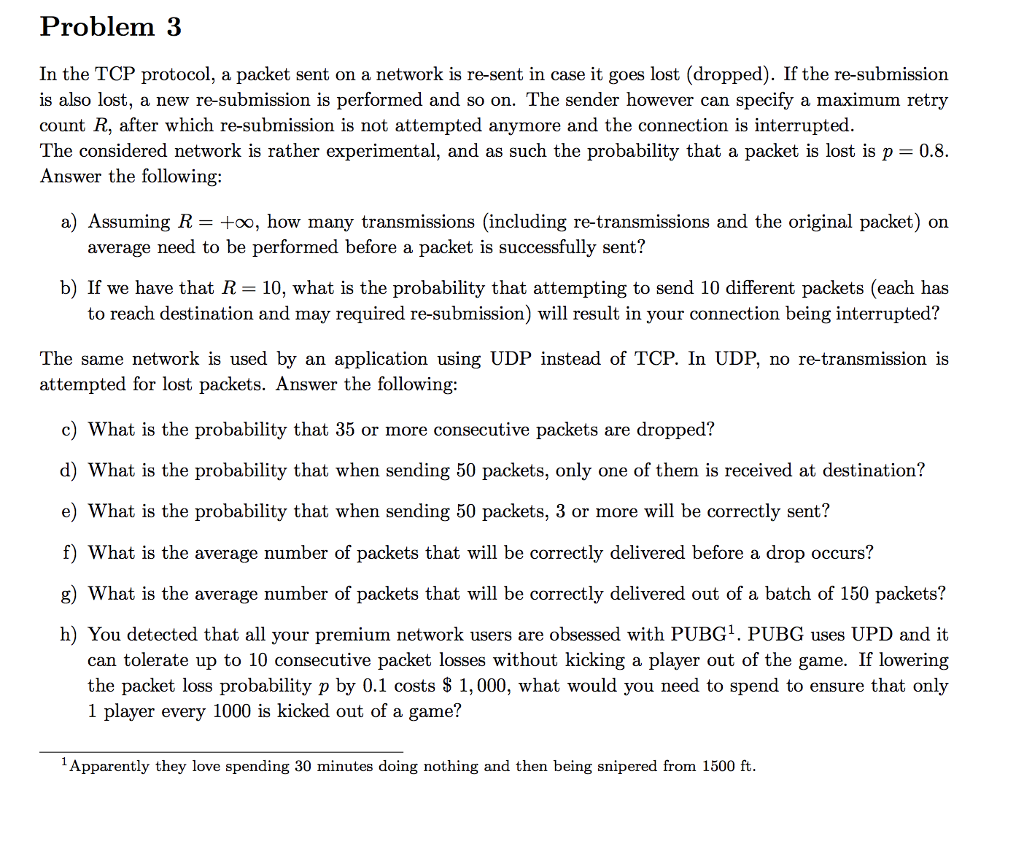
Problem 3 In the TCP protocol, a packet sent on a network is re-sent in case it goes lost (dropped). If the re-submission is also lost, a new re-submission is performed and so on. The sender however can specify a maximum retry count R, after which re-submission is not attempted anymore and the connection is interrupted The considered network is rather experimental, and as such the probability that a packet is lost is p = 0.8. Answer the following: a) Assuming R- +oo, how many transmissions (including re-transmissions and the original packet) on average need to be performed before a packet is successfully sent? b) If we have that R- 10, what is the probability that attempting to send 10 different packets (each has to reach destination and may required re-submission) will result in your connection being interrupted? The same network is used by an application using UDP instead of TCP. In UDP, no re-transmission is attempted for lost packets. Answer the following: c) What is the probability that 35 or more consecutive packets are dropped? d) What is the probability that when sending 50 packets, only one of them is received at destination? e) What is the probability that when sending 50 packets, 3 or more will be correctly sent? f) What is the average number of packets that will be correctly delivered before a drop occurs? g) What is the average number of packets that will be correctly delivered out of a batch of 150 packets? h) You detected that all your premium network users are obsessed with PUBG1. PUBG uses UPD and it can tolerate up to 10 consecutive packet losses without kicking a player out of the game. If lowering the packet loss probability p by 0.1 costs S 1,000, what would you need to spend to ensure that only 1 player every 1000 is kicked out of a game? Apparently they love spending 30 minutes doing nothing and then being snipered from 1500 ft Problem 3 In the TCP protocol, a packet sent on a network is re-sent in case it goes lost (dropped). If the re-submission is also lost, a new re-submission is performed and so on. The sender however can specify a maximum retry count R, after which re-submission is not attempted anymore and the connection is interrupted The considered network is rather experimental, and as such the probability that a packet is lost is p = 0.8. Answer the following: a) Assuming R- +oo, how many transmissions (including re-transmissions and the original packet) on average need to be performed before a packet is successfully sent? b) If we have that R- 10, what is the probability that attempting to send 10 different packets (each has to reach destination and may required re-submission) will result in your connection being interrupted? The same network is used by an application using UDP instead of TCP. In UDP, no re-transmission is attempted for lost packets. Answer the following: c) What is the probability that 35 or more consecutive packets are dropped? d) What is the probability that when sending 50 packets, only one of them is received at destination? e) What is the probability that when sending 50 packets, 3 or more will be correctly sent? f) What is the average number of packets that will be correctly delivered before a drop occurs? g) What is the average number of packets that will be correctly delivered out of a batch of 150 packets? h) You detected that all your premium network users are obsessed with PUBG1. PUBG uses UPD and it can tolerate up to 10 consecutive packet losses without kicking a player out of the game. If lowering the packet loss probability p by 0.1 costs S 1,000, what would you need to spend to ensure that only 1 player every 1000 is kicked out of a game? Apparently they love spending 30 minutes doing nothing and then being snipered from 1500 ft
Step by Step Solution
There are 3 Steps involved in it

Get step-by-step solutions from verified subject matter experts
 Study Help