







Question: Problem 3 In this problem, we explore tensions between two common fairness definitions. Suppose that the pop- ulation consists of two groups, one with sensitive
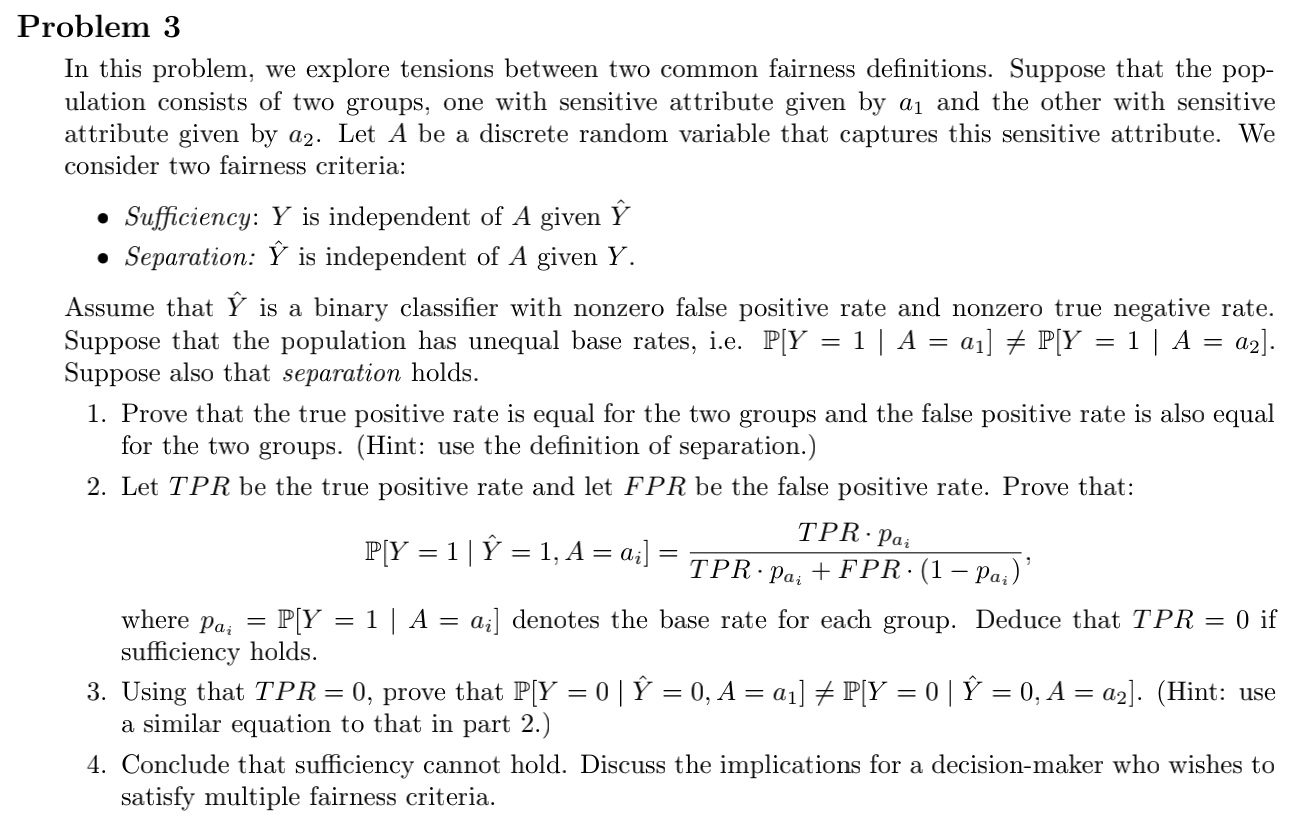
Problem 3 In this problem, we explore tensions between two common fairness definitions. Suppose that the pop- ulation consists of two groups, one with sensitive attribute given by an and the other with sensitive attribute given by a2. Let A be a discrete random variable that captures this sensitive attribute. We consider two fairness criteria: . Sufficiency: Y is independent of A given Y . Separation: Y is independent of A given Y. Assume that Y is a binary classifier with nonzero false positive rate and nonzero true negative rate. Suppose that the population has unequal base rates, i.e. P[Y = 1 [ A = al] # P[Y = 1 | A = a2]. Suppose also that separation holds. 1. Prove that the true positive rate is equal for the two groups and the false positive rate is also equal for the two groups. (Hint: use the definition of separation. ) 2. Let TPR be the true positive rate and let FPR be the false positive rate. Prove that: TPR . Pai PY = 1|Y = 1, A= di] = TPR . pa; + FPR . (1 -Pai) where Pa; = P[Y = 1 | A = a;] denotes the base rate for each group. Deduce that TPR = 0 if sufficiency holds. 3. Using that TPR = 0, prove that P[Y = 0 | Y = 0, A = al] # P[Y = 0 | Y = 0, A = a2]. (Hint: use a similar equation to that in part 2.) 4. Conclude that sufficiency cannot hold. Discuss the implications for a decision-maker who wishes to satisfy multiple fairness criteria
Step by Step Solution
There are 3 Steps involved in it

Get step-by-step solutions from verified subject matter experts
 Study Help