





Question: Problem 3. Let a now be an algebraic number. Choose f{:r) to be a polynomial with integer coefcients such that at) = l] and f(ct)
Problem 3. Let a now be an algebraic number.
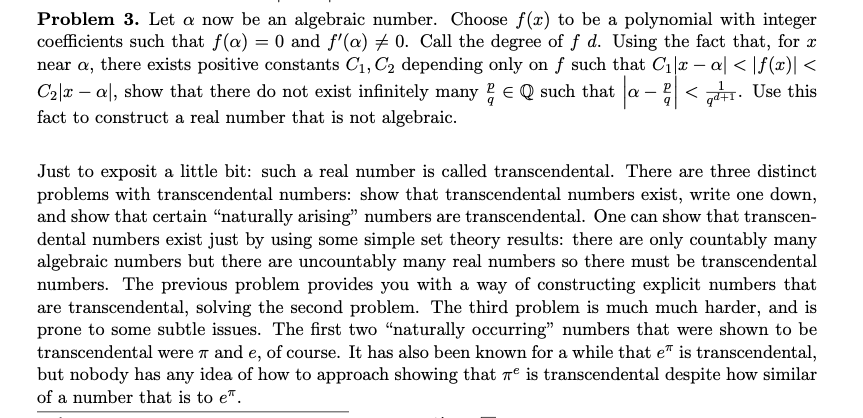
Problem 3. Let a now be an algebraic number. Choose f{:r) to be a polynomial with integer coefcients such that at) = l] and f"(ct) 5'5 0. Call the degree of f :1. Using the fact that, for it: near or, there exists positive constants 01,03 depending only on f such that (3'1 1: oil 4: | f[:|:)| r: 02h: is, show that there do not exist innitely many 3 e Q such that la 43 c Fig. Use this fact to construct a real number that is not algebraic. Just to exposit a little bit: such a real number is called transcendental. There are three distinct problems with transcendental numbers: show that transcendental numbers exist, write one down, and show that certain \"naturally arising\" numbers are transcendental. One can show that transcen- dental numbers exist just by using some simple set theory results: there are only countably many algebraic numbers but there are uncountably many real numbers so there must be transcendental numbers. The previous problem provides you with a way of constructing explicit numbers that are transcendental, solving the second problem. The third problem is much much harder, and is prone to some subtle issues. The rst two \"naturally occurring\" numbers that were shown to be transcendental were 1r and e, of course. It has also been known for a while that e'r is transcendental, but nobody has any idea of how to approach showing that are is transcendental despite how similar of a number that is to e\

Step by Step Solution

There are 3 Steps involved in it

1 Expert Approved Answer
Step: 1 Unlock blur-text-image

Question Has Been Solved by an Expert!

Get step-by-step solutions from verified subject matter experts

Step: 2 Unlock
Step: 3 Unlock

Students Have Also Explored These Related Mathematics Questions!