







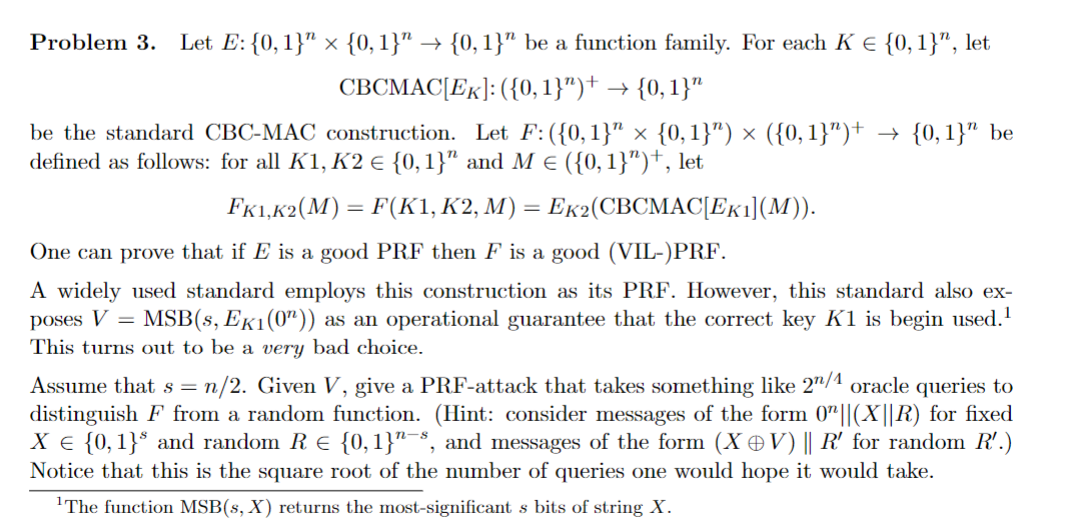
Question: Problem 3 . Let E : { 0 , 1 } n { 0 , 1 } n { 0 , 1 } n be
Problem Let : be a function family. For each Kin let
CBCMAC:
be the standard CBCMAC construction. Let : be
defined as follows: for all and Min let
One can prove that if is a good PRF then is a good VILPRF
A widely used standard employs this construction as its PRF However, this standard also ex
poses as an operational guarantee that the correct key is begin used.
This turns out to be a very bad choice.
Assume that Given give a PRFattack that takes something like oracle queries to
distinguish from a random function. Hint: consider messages of the form for fixed
xin and random Rin and messages of the form for random
Notice that this is the square root of the number of queries one would hope it would take.
The function returns the mostsignificant bits of string
Step by Step Solution
There are 3 Steps involved in it
1 Expert Approved Answer
Step: 1 Unlock

Question Has Been Solved by an Expert!
Get step-by-step solutions from verified subject matter experts
Step: 2 Unlock
Step: 3 Unlock
 Study Help