







Question: Problem 3. Let S be the set of binary strings in which every block b of Os is followed by a block of ls, whose
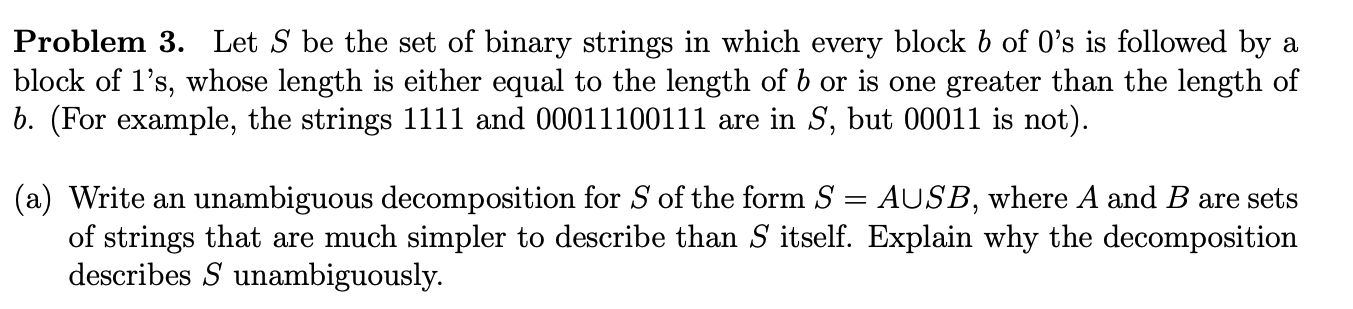
Problem 3. Let S be the set of binary strings in which every block b of Os is followed by a block of ls, whose length is either equal to the length of b or is one greater than the length of b. (For example, the strings 1111 and 00011100111 are in S, but 00011 is not). (a) Write an unambiguous decomposition for S of the form S = AUSB, where A and B are sets of strings that are much simpler to describe than S itself. Explain why the decomposition describes S unambiguously. Problem 3. Let S be the set of binary strings in which every block b of Os is followed by a block of ls, whose length is either equal to the length of b or is one greater than the length of b. (For example, the strings 1111 and 00011100111 are in S, but 00011 is not). (a) Write an unambiguous decomposition for S of the form S = AUSB, where A and B are sets of strings that are much simpler to describe than S itself. Explain why the decomposition describes S unambiguously
Step by Step Solution
There are 3 Steps involved in it

Get step-by-step solutions from verified subject matter experts
 Study Help