







Question: Problem 3 - Linear Discriminant Analysis: Consider the categorical learning problem consisting of a data set with two labels: Label 1: X1 X2 3.81 0.23
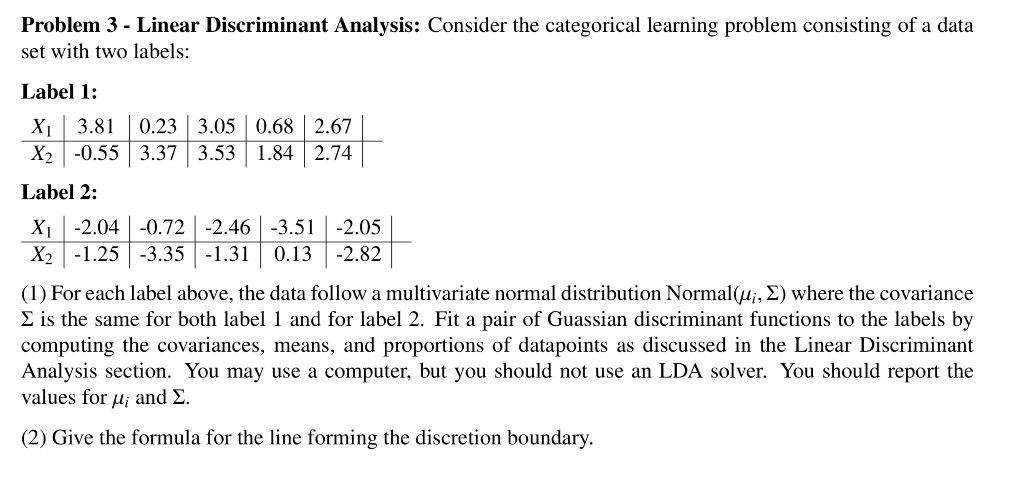
Problem 3 - Linear Discriminant Analysis: Consider the categorical learning problem consisting of a data set with two labels: Label 1: X1 X2 3.81 0.23 3.05 0.68 2.67 -0.55 3.37 3.53 1.84 2.74 Label 2: X; -2.04 -0.72 -2.46 -3.51 -2.05 X2 -1.25 -3.35 -1.310.13 -2.82 (1) For each label above, the data follow a multivariate normal distribution Normal(ui, ) where the covariance E is the same for both label 1 and for label 2. Fit a pair of Guassian discriminant functions to the labels by computing the covariances, means, and proportions of datapoints as discussed in the Linear Discriminant Analysis section. You may use a computer, but you should not use an LDA solver. You should report the values for fi and E. (2) Give the formula for the line forming the discretion boundary. Problem 3 - Linear Discriminant Analysis: Consider the categorical learning problem consisting of a data set with two labels: Label 1: X1 X2 3.81 0.23 3.05 0.68 2.67 -0.55 3.37 3.53 1.84 2.74 Label 2: X; -2.04 -0.72 -2.46 -3.51 -2.05 X2 -1.25 -3.35 -1.310.13 -2.82 (1) For each label above, the data follow a multivariate normal distribution Normal(ui, ) where the covariance E is the same for both label 1 and for label 2. Fit a pair of Guassian discriminant functions to the labels by computing the covariances, means, and proportions of datapoints as discussed in the Linear Discriminant Analysis section. You may use a computer, but you should not use an LDA solver. You should report the values for fi and E. (2) Give the formula for the line forming the discretion boundary
Step by Step Solution
There are 3 Steps involved in it

Get step-by-step solutions from verified subject matter experts
 Study Help