







Question: Problem 3. (max. 10 points) Again, we will work with the electric force field, as in the previous problem, but in R now: ke Qq
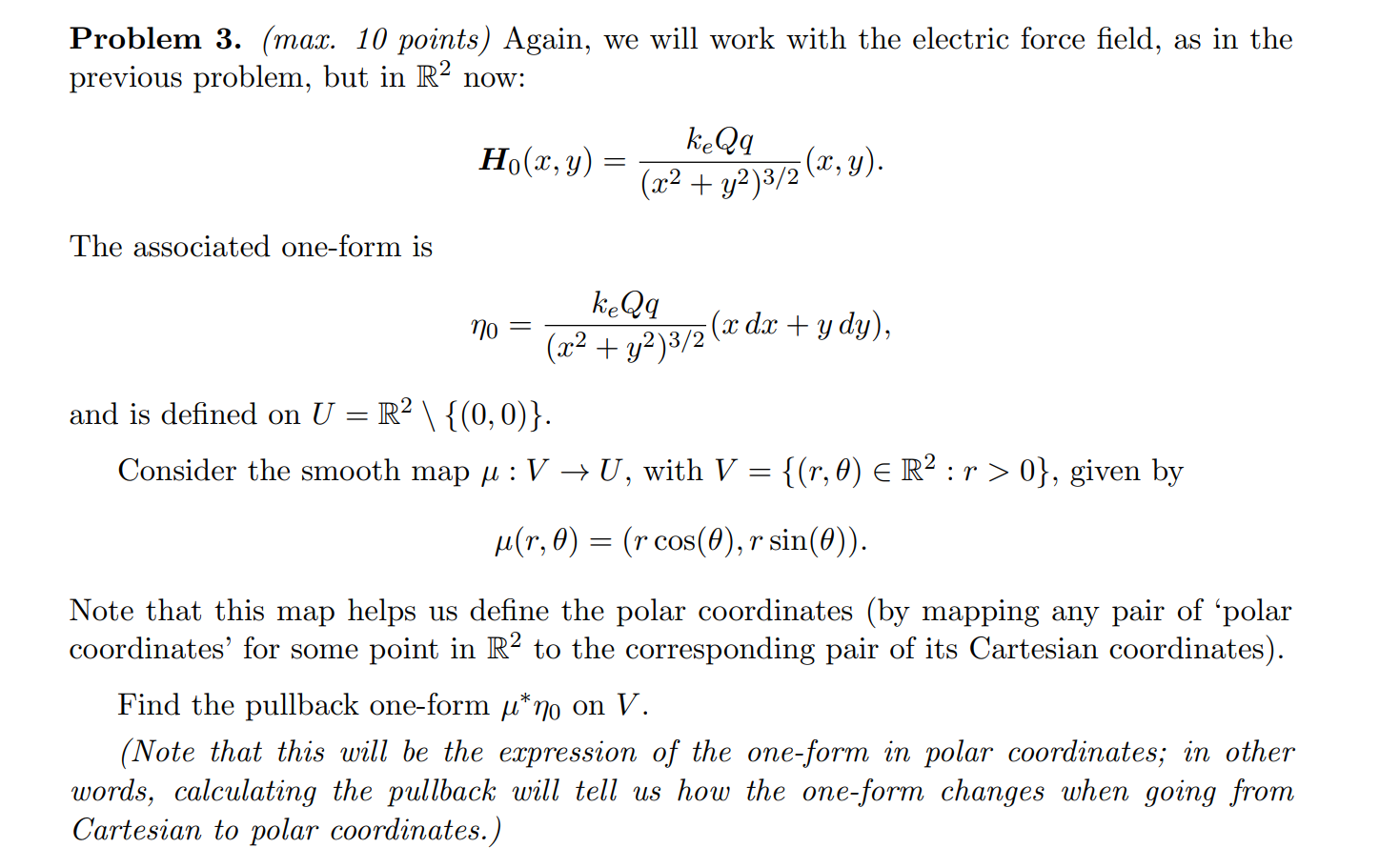
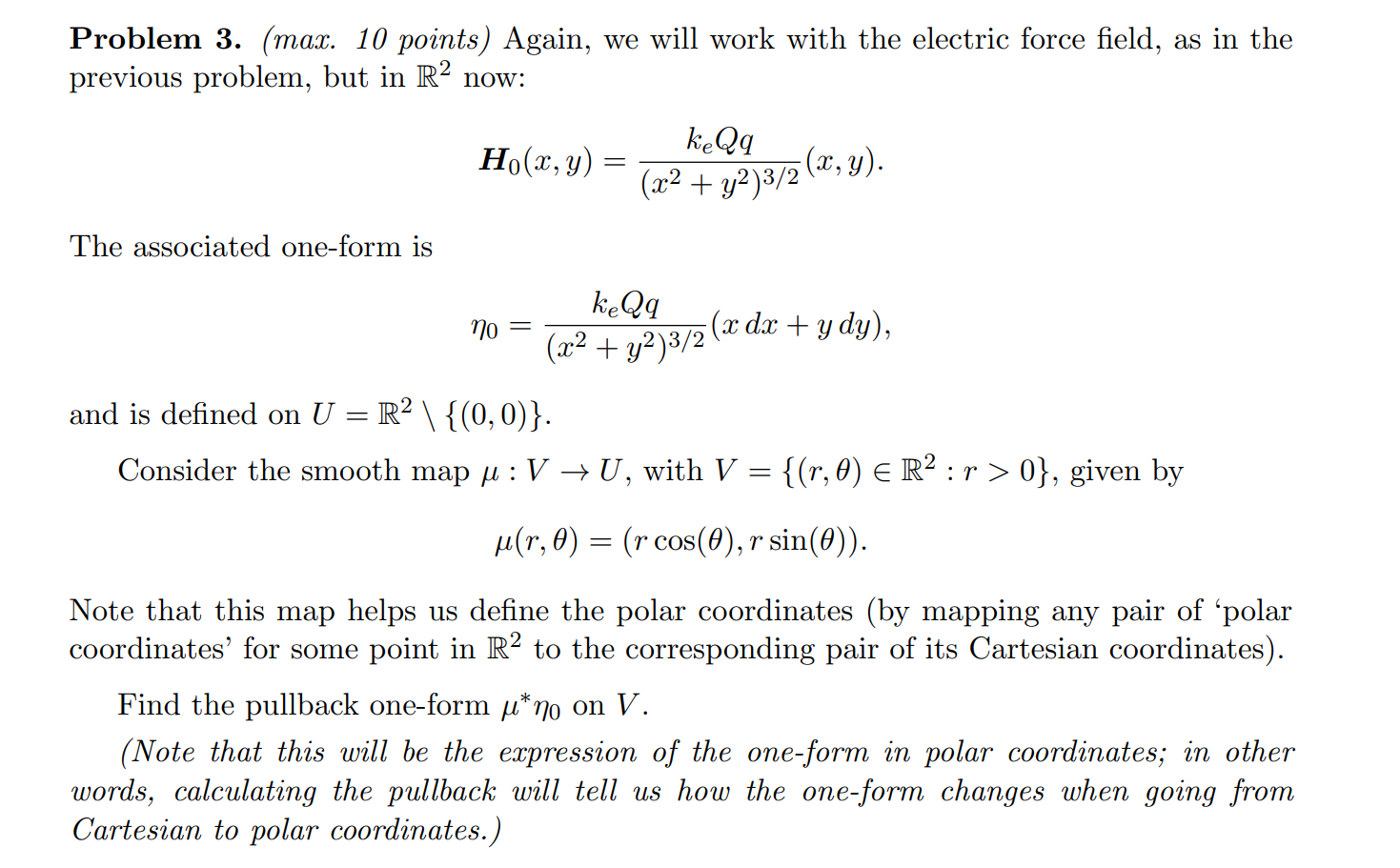
Problem 3. (max. 10 points) Again, we will work with the electric force field, as in the previous problem, but in R now: ke Qq Ho(x, y) = ( 2 2 + 2 2 ) 3/2 ( , y ) . The associated one-form is keQq no = (x2 + 22) 3/2 (x dx + y dy), and is defined on U = R2 \ { (0, 0) }. Consider the smooth map u : V - U, with V = {(r, 0) E R2 : r > 0}, given by u(r, 0) = (r cos(0), r sin(0)). Note that this map helps us define the polar coordinates (by mapping any pair of 'polar coordinates' for some point in R2 to the corresponding pair of its Cartesian coordinates). Find the pullback one-form * no on V. (Note that this will be the expression of the one-form in polar coordinates; in other words, calculating the pullback will tell us how the one-form changes when going from Cartesian to polar coordinates. )
Step by Step Solution
There are 3 Steps involved in it

Get step-by-step solutions from verified subject matter experts
 Study Help