







Question: Problem 3 (Risk and Uncertainty, 3 points) We consider a decision problem of investment in risky assets, The decision maker can invest in bonds or
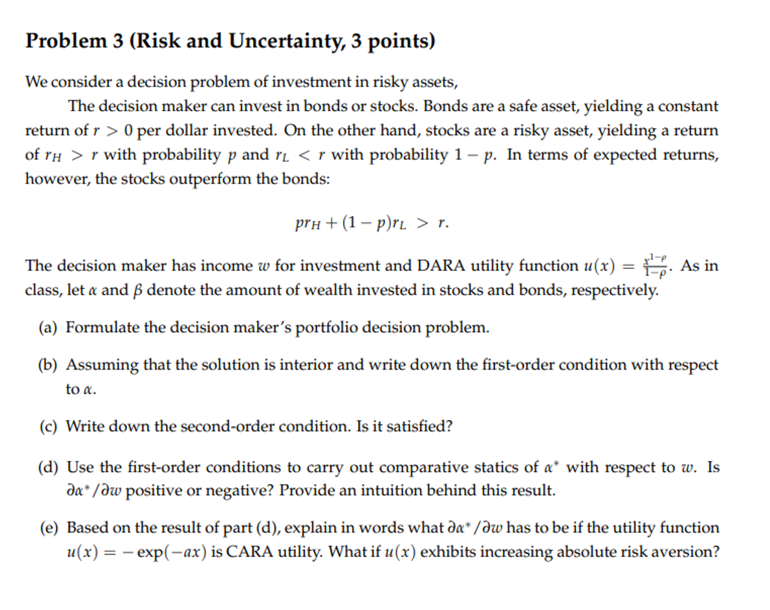
Problem 3 (Risk and Uncertainty, 3 points) We consider a decision problem of investment in risky assets, The decision maker can invest in bonds or stocks. Bonds are a safe asset, yielding a constant return of r > 0 per dollar invested. On the other hand, stocks are a risky asset, yielding a return of rh > r with probability p and r r. The decision maker has income w for investment and DARA utility function u(x) = . As in class, let & and denote the amount of wealth invested in stocks and bonds, respectively. (a) Formulate the decision maker's portfolio decision problem. (b) Assuming that the solution is interior and write down the first-order condition with respect to a. (e) Write down the second-order condition. Is it satisfied? (d) Use the first-order conditions to carry out comparative statics of a* with respect to w. Is da* /w positive or negative? Provide an intuition behind this result. (e) Based on the result of part (d), explain in words what da* /aw has to be if the utility function u(x) = -exp(-ax) is CARA utility. What if u(x) exhibits increasing absolute risk aversion? Problem 3 (Risk and Uncertainty, 3 points) We consider a decision problem of investment in risky assets, The decision maker can invest in bonds or stocks. Bonds are a safe asset, yielding a constant return of r > 0 per dollar invested. On the other hand, stocks are a risky asset, yielding a return of rh > r with probability p and r r. The decision maker has income w for investment and DARA utility function u(x) = . As in class, let & and denote the amount of wealth invested in stocks and bonds, respectively. (a) Formulate the decision maker's portfolio decision problem. (b) Assuming that the solution is interior and write down the first-order condition with respect to a. (e) Write down the second-order condition. Is it satisfied? (d) Use the first-order conditions to carry out comparative statics of a* with respect to w. Is da* /w positive or negative? Provide an intuition behind this result. (e) Based on the result of part (d), explain in words what da* /aw has to be if the utility function u(x) = -exp(-ax) is CARA utility. What if u(x) exhibits increasing absolute risk aversion
Step by Step Solution
There are 3 Steps involved in it

Get step-by-step solutions from verified subject matter experts
 Study Help