







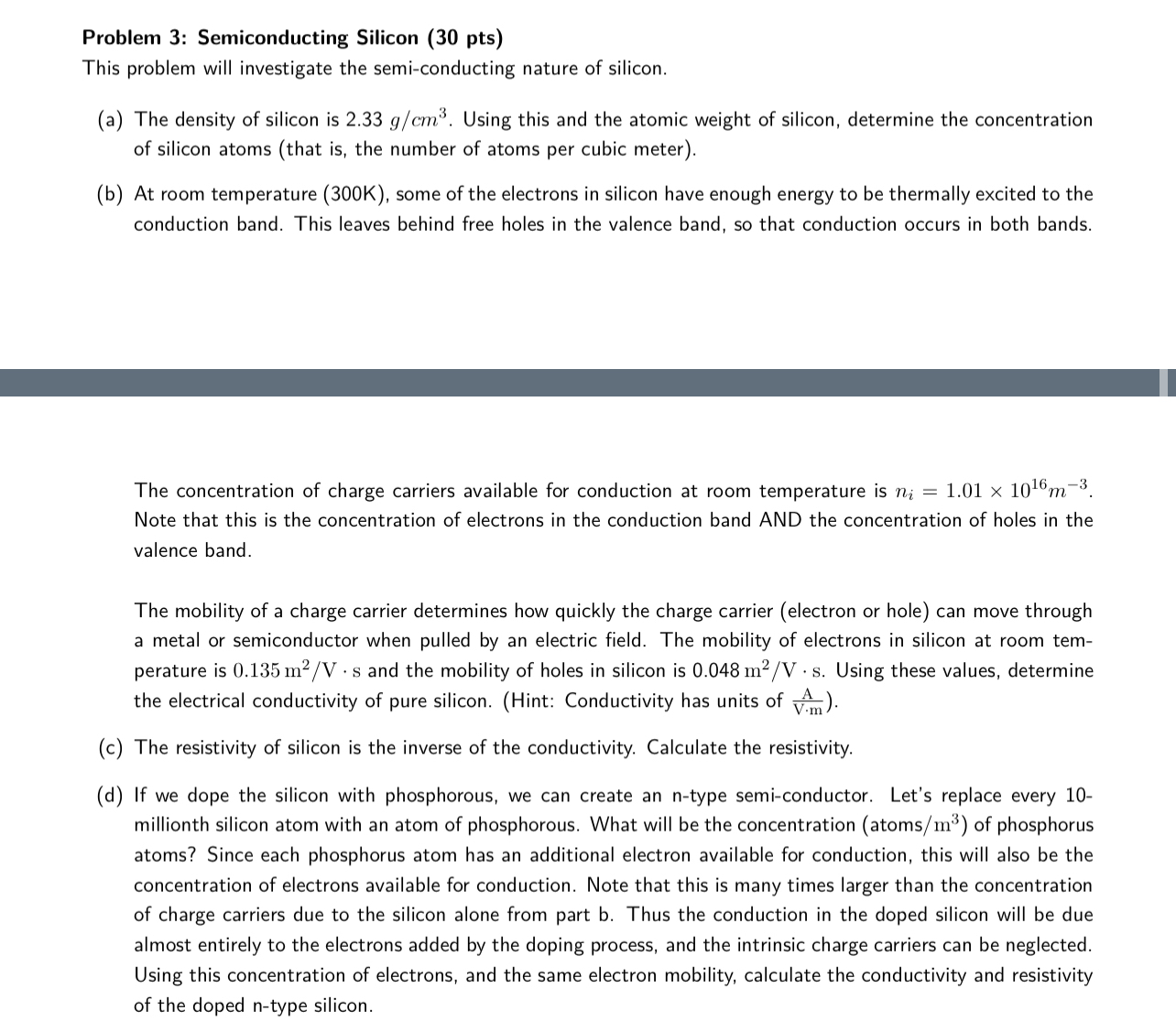
Question: Problem 3 : Semiconducting Silicon ( 3 0 pts ) This problem will investigate the semi - conducting nature of silicon. ( a ) The
Problem : Semiconducting Silicon pts
This problem will investigate the semiconducting nature of silicon.
a The density of silicon is Using this and the atomic weight of silicon, determine the concentration of silicon atoms that is the number of atoms per cubic meter
b At room temperature K some of the electrons in silicon have enough energy to be thermally excited to the conduction band. This leaves behind free holes in the valence band, so that conduction occurs in both bands.
The concentration of charge carriers available for conduction at room temperature is Note that this is the concentration of electrons in the conduction band AND the concentration of holes in the valence band.
The mobility of a charge carrier determines how quickly the charge carrier electron or hole can move through a metal or semiconductor when pulled by an electric field. The mobility of electrons in silicon at room temperature is and the mobility of holes in silicon is Using these values, determine the electrical conductivity of pure silicon. Hint: Conductivity has units of
c The resistivity of silicon is the inverse of the conductivity. Calculate the resistivity.
d If we dope the silicon with phosphorous, we can create an ntype semiconductor. Let's replace every millionth silicon atom with an atom of phosphorous. What will be the concentration atoms of phosphorus atoms? Since each phosphorus atom has an additional electron available for conduction, this will also be the concentration of electrons available for conduction. Note that this is many times larger than the concentration of charge carriers due to the silicon alone from part b Thus the conduction in the doped silicon will be due almost entirely to the electrons added by the doping process, and the intrinsic charge carriers can be neglected. Using this concentration of electrons, and the same electron mobility, calculate the conductivity and resistivity of the doped ntype silicon.
Step by Step Solution
There are 3 Steps involved in it
1 Expert Approved Answer
Step: 1 Unlock

Question Has Been Solved by an Expert!
Get step-by-step solutions from verified subject matter experts
Step: 2 Unlock
Step: 3 Unlock
 Study Help