







Question: problem 3. set-up: you collect a random sample of articles penned by FZ and count how many times he uses the certain word I in
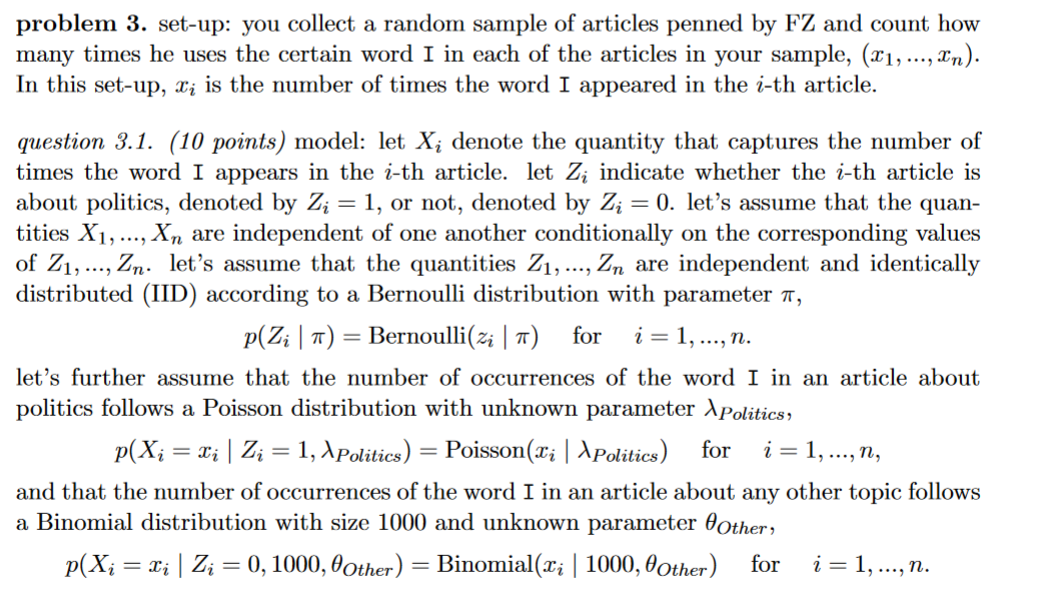

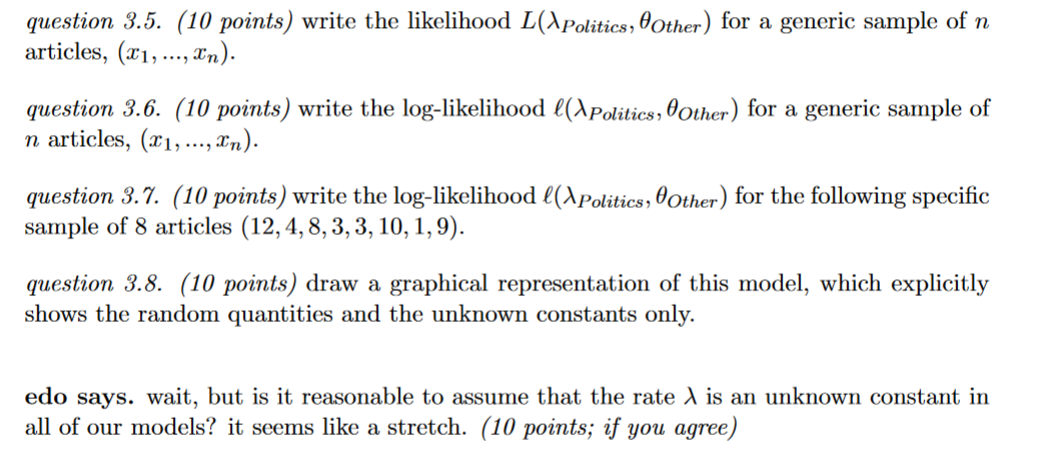
problem 3. set-up: you collect a random sample of articles penned by FZ and count how many times he uses the certain word I in each of the articles in your sample, (x1, ..., En). In this set-up, Xi is the number of times the word I appeared in the i-th article. = question 3.1. (10 points) model: let X; denote the quantity that captures the number of times the word I appears in the i-th article. let Zi indicate whether the i-th article is about politics, denoted by Zi = 1, or not, denoted by Zi = 0. let's assume that the quan- tities X1, ..., Xn are independent of one another conditionally on the corresponding values of Z1, ..., Zn. let's assume that the quantities Z1, ..., Zn are independent and identically distributed (IID) according to a Bernoulli distribution with parameter 1, p(Zi | 7) = Bernoulli(ai | 7) for i=1, ..., n. let's further assume that the number of occurrences of the word I in an article about politics follows a Poisson distribution with unknown parameter Politics, p(X; = Ti | Zi = 1, \Politics) = Poisson(Ii | \Politics) for i= 1, ..., n, and that the number of occurrences of the word I in an article about any other topic follows a Binomial distribution with size 1000 and unknown parameter Oother, p(Xi = ri | Zi = 0,1000,00ther) = Binomial(.ri | 1000, 6other) for i= 1, ..., n. = using the 2-by-2 table of whats variable/constant versus what's observed/unknown, declare what's the technical nature (random variable, latent variable, known constant or unknown constant) of the quantities involved the set-up/model above: X1, ..Xn, 21, ...In, Z1,..Zn, 21, ...Zn, 7, \Politics, mother and n. question 3.5. (10 points) write the likelihood L(Politics, bother) for a generic sample of n articles, (x1, ..., Xn). question 3.6. (10 points) write the log-likelihood l(Politics, (Other) for a generic sample of n articles, (21, ..., Xn). question 3.7. (10 points) write the log-likelihood l(\Politics, (Other) for the following specific sample of 8 articles (12,4,8,3, 3, 10, 1,9). question 3.8. (10 points) draw a graphical representation of this model, which explicitly shows the random quantities and the unknown constants only. edo says. wait, but is it reasonable to assume that the rate is an unknown constant in all of our models? it seems like a stretch. (10 points; if you agree) problem 3. set-up: you collect a random sample of articles penned by FZ and count how many times he uses the certain word I in each of the articles in your sample, (x1, ..., En). In this set-up, Xi is the number of times the word I appeared in the i-th article. = question 3.1. (10 points) model: let X; denote the quantity that captures the number of times the word I appears in the i-th article. let Zi indicate whether the i-th article is about politics, denoted by Zi = 1, or not, denoted by Zi = 0. let's assume that the quan- tities X1, ..., Xn are independent of one another conditionally on the corresponding values of Z1, ..., Zn. let's assume that the quantities Z1, ..., Zn are independent and identically distributed (IID) according to a Bernoulli distribution with parameter 1, p(Zi | 7) = Bernoulli(ai | 7) for i=1, ..., n. let's further assume that the number of occurrences of the word I in an article about politics follows a Poisson distribution with unknown parameter Politics, p(X; = Ti | Zi = 1, \Politics) = Poisson(Ii | \Politics) for i= 1, ..., n, and that the number of occurrences of the word I in an article about any other topic follows a Binomial distribution with size 1000 and unknown parameter Oother, p(Xi = ri | Zi = 0,1000,00ther) = Binomial(.ri | 1000, 6other) for i= 1, ..., n. = using the 2-by-2 table of whats variable/constant versus what's observed/unknown, declare what's the technical nature (random variable, latent variable, known constant or unknown constant) of the quantities involved the set-up/model above: X1, ..Xn, 21, ...In, Z1,..Zn, 21, ...Zn, 7, \Politics, mother and n. question 3.5. (10 points) write the likelihood L(Politics, bother) for a generic sample of n articles, (x1, ..., Xn). question 3.6. (10 points) write the log-likelihood l(Politics, (Other) for a generic sample of n articles, (21, ..., Xn). question 3.7. (10 points) write the log-likelihood l(\Politics, (Other) for the following specific sample of 8 articles (12,4,8,3, 3, 10, 1,9). question 3.8. (10 points) draw a graphical representation of this model, which explicitly shows the random quantities and the unknown constants only. edo says. wait, but is it reasonable to assume that the rate is an unknown constant in all of our models? it seems like a stretch. (10 points; if you agree)
Step by Step Solution
There are 3 Steps involved in it

Get step-by-step solutions from verified subject matter experts
 Study Help