







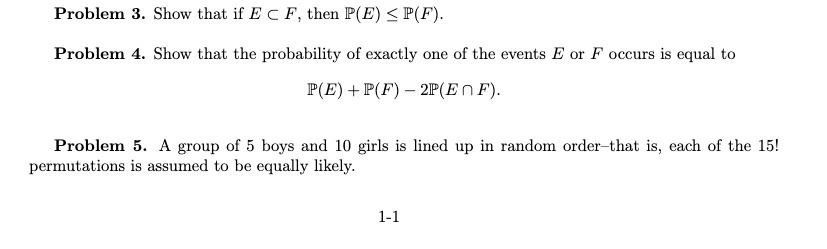
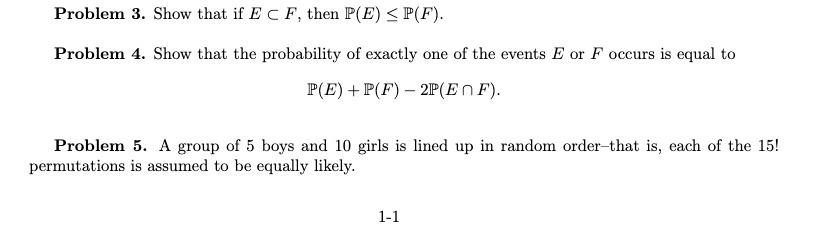
Question: Problem 3. Show that if E C F, then P(E) Problem 3. Show that if E C F, then P(E) P(F). Problem 4. Show that
Problem 3. Show that if E C F, then P(E)
Problem 3. Show that if E C F, then P(E) P(F). Problem 4. Show that the probability of exactly one of the events E or F occurs is equal to P(E) + P(F) - 2P(E n F). Problem 5. A group of 5 boys and 10 girls is lined up in random orderthat is, each of the 15! permutations is assumed to be equally likely. 1-1
Step by Step Solution
There are 3 Steps involved in it
1 Expert Approved Answer
Step: 1 Unlock

Question Has Been Solved by an Expert!
Get step-by-step solutions from verified subject matter experts
Step: 2 Unlock
Step: 3 Unlock
 Study Help