







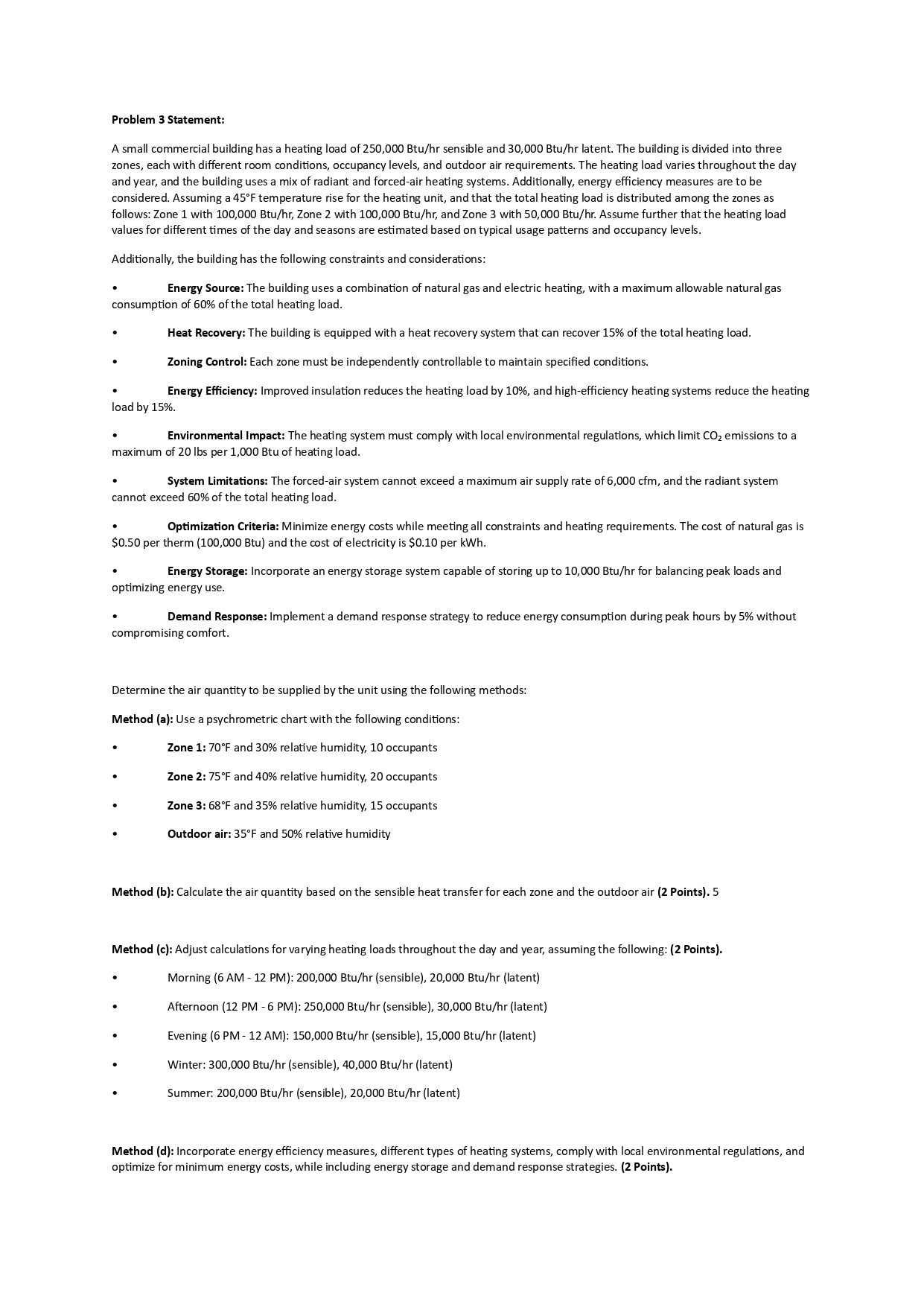
Question: Problem 3 Statement: A small commercial building has a heating load of ( 2 5 0 , 0 0 0 mathrm { Btu
Problem Statement:
A small commercial building has a heating load of mathrmBtumathrmhr sensible and mathrmBtumathrmhr latent. The building is divided into three zones, each with different room conditions, occupancy levels, and outdoor air requirements. The heating load varies throughout the day and year, and the building uses a mix of radiant and forcedair heating systems. Additionally, energy efficiency measures are to be considered. Assuming a circmathrmF temperature rise for the heating unit, and that the total heating load is distributed among the zones as follows: Zone with Btuhr Zone with mathrmBtumathrmhr and Zone with mathrmBtumathrmhr Assume further that the heating load values for different times of the day and seasons are estimated based on typical usage patterns and occupancy levels.
Additionally, the building has the following constraints and considerations:
Energy Source: The building uses a combination of natural gas and electric heating, with a maximum allowable natural gas consumption of of the total heating load.
Heat Recovery: The building is equipped with a heat recovery system that can recover of the total heating load.
Zoning Control: Each zone must be independently controllable to maintain specified conditions.
Energy Efficiency: Improved insulation reduces the heating load by and highefficiency heating systems reduce the heating load by
Environmental Impact: The heating system must comply with local environmental regulations, which limit mathrmCO emissions to a maximum of lbs per Btu of heating load.
System Limitations: The forcedair system cannot exceed a maximum air supply rate of cfm and the radiant system cannot exceed of the total heating load.
Optimization Criteria: Minimize energy costs while meeting all constraints and heating requirements. The cost of natural gas is $ per therm mathrmBtu and the cost of electricity is $ per kWh
quad Energy Storage: Incorporate an energy storage system capable of storing up to Btuhr for balancing peak loads and optimizing energy use.
Demand Response: Implement a demand response strategy to reduce energy consumption during peak hours by without compromising comfort.
Determine the air quantity to be supplied by the unit using the following methods:
Method a: Use a psychrometric chart with the following conditions:
Zone : circmathrmF and relative humidity, occupants
Zone : circmathrmF and relative humidity, occupants
Zone : circmathrmF and relative humidity, occupants
quad Outdoor air: circmathrmF and relative humidity
Method b: Calculate the air quantity based on the sensible heat transfer for each zone and the outdoor air Points
Method c: Adjust calculations for varying heating loads throughout the day and year, assuming the following: Points
Morning AM PM: Btuhr sensible Btuhr latent
quad Afternoon PM PM: mathrmBtumathrmhrsensible Btuhr latent
Evening PM AM : Btuhr sensiblemathrmBtumathrmhrlatent
Winter: mathrmBtumathrmhrsensiblemathrmBtumathrmhrlatent
Summer: mathrmBtumathrmhrsensiblemathrmBtumathrmhrlatent
Method d: Incorporate energy efficiency measures, different types of heating systems, comply with local environmental regulations, and optimize for minimum energy costs, while including energy storage and demand response strategies. Points
Step by Step Solution
There are 3 Steps involved in it
1 Expert Approved Answer
Step: 1 Unlock

Question Has Been Solved by an Expert!
Get step-by-step solutions from verified subject matter experts
Step: 2 Unlock
Step: 3 Unlock
 Study Help