



Question: Problem 3 Suppose a firm's profit function is a(p) = (p + 1) log(P + 1) (p+1) where the logarithm is base e (we will
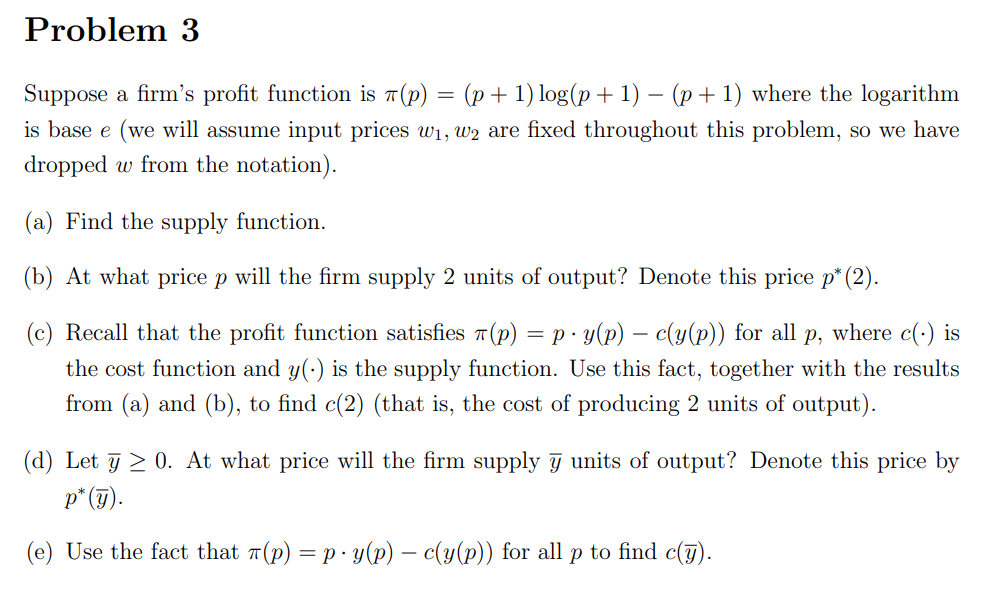
Problem 3 Suppose a firm's profit function is a(p) = (p + 1) log(P + 1) (p+1) where the logarithm is base e (we will assume input prices w1, W2 are fixed throughout this problem, so we have dropped w from the notation). (a) Find the supply function. (b) At what price p will the firm supply 2 units of output? Denote this price p* (2). = (c) Recall that the profit function satisfies #(p) = p y(p) c(y(p)) for all p, where c(-) is the cost function and y() is the supply function. Use this fact, together with the results from (a) and (b), to find c(2) (that is, the cost of producing 2 units of output). (d) Let y > 0. At what price will the firm su y units of output? Denote this price by p*(T). (e) Use the fact that a(p) = p y(p) c(y(p)) for all p to find c()
Step by Step Solution
There are 3 Steps involved in it

Get step-by-step solutions from verified subject matter experts