







Question: Problem 3 (Symbol Table Memory Usage, 25 points) Consider these three symbol table implementations from our book: RedBlackBST (pages 433-439 or here ), SeparateChainingHashST (page
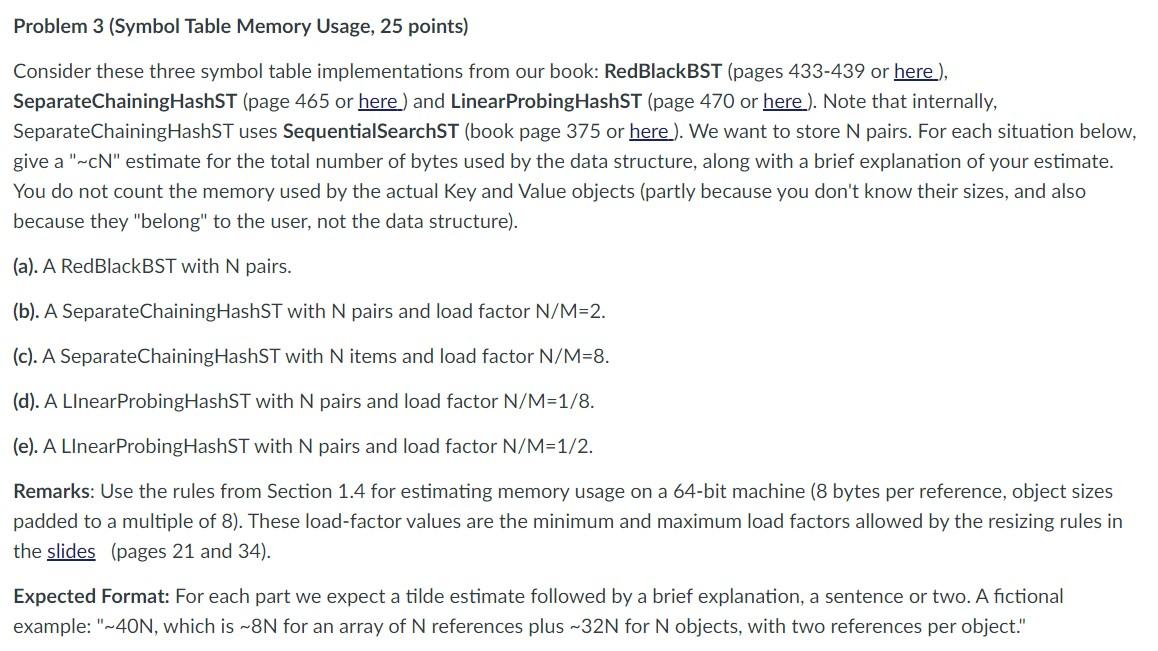
Problem 3 (Symbol Table Memory Usage, 25 points) Consider these three symbol table implementations from our book: RedBlackBST (pages 433-439 or here ), SeparateChainingHashST (page 465 or here) and LinearProbingHashST (page 470 or here). Note that internally, SeparateChainingHashST uses SequentialSearchST (book page 375 or here ). We want to store N pairs. For each situation below, give a " cN " estimate for the total number of bytes used by the data structure, along with a brief explanation of your estimate. You do not count the memory used by the actual Key and Value objects (partly because you don't know their sizes, and also because they "belong" to the user, not the data structure). (a). A RedBlackBST with N pairs. (b). A SeparateChainingHashST with N pairs and load factor N/M=2. (c). A SeparateChainingHashST with N items and load factor N/M=8. (d). A LInearProbingHashST with N pairs and load factor N/M=1/8. (e). A LInearProbingHashST with N pairs and load factor N/M=1/2. Remarks: Use the rules from Section 1.4 for estimating memory usage on a 64-bit machine ( 8 bytes per reference, object sizes padded to a multiple of 8). These load-factor values are the minimum and maximum load factors allowed by the resizing rules in the slides (pages 21 and 34). Expected Format: For each part we expect a tilde estimate followed by a brief explanation, a sentence or two. A fictional example: " 40N, which is 8N for an array of N references plus 32N for N objects, with two references per object
Step by Step Solution
There are 3 Steps involved in it

Get step-by-step solutions from verified subject matter experts
 Study Help