







Question: Problem 3 : The command module has performed a deorbit burn and is reentering Earth's atmosphere at a velocity of ( 2 8 ,
Problem :
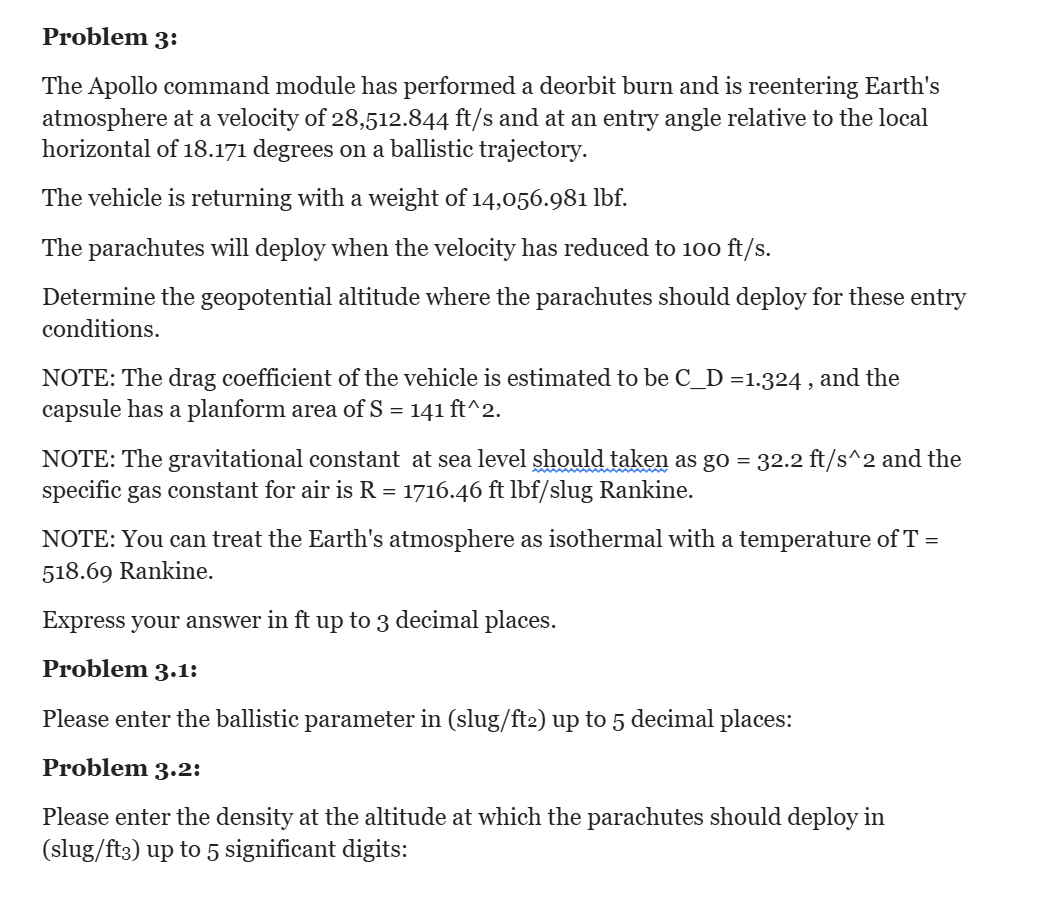
The command module has performed a deorbit burn and is reentering Earth's atmosphere at a velocity of mathrmftmathrms and at an entry angle relative to the local horizontal of degrees on a ballistic trajectory.
The vehicle is returning with a weight of lbf
The parachutes will deploy when the velocity has reduced to mathrmftmathrms
Determine the geopotential altitude where the parachutes should deploy for these entry conditions.
NOTE: The drag coefficient of the vehicle is estimated to be CD and the capsule has a planform area of mathrmSmathrmftwedge
NOTE: The gravitational constant at sea level should taken as go mathrmftmathrmswedge and the specific gas constant for air is mathrmRmathrmftmathrmlbf slug Rankine.
NOTE: You can treat the Earth's atmosphere as isothermal with a temperature of mathrmT Rankine.
Express your answer in ft up to decimal places.
Problem :
Please enter the ballistic parameter in slugft up to decimal places:
Problem :
Please enter the density at the altitude at which the parachutes should deploy in slugmathrmft up to significant digits:
Step by Step Solution
There are 3 Steps involved in it
1 Expert Approved Answer
Step: 1 Unlock

Question Has Been Solved by an Expert!
Get step-by-step solutions from verified subject matter experts
Step: 2 Unlock
Step: 3 Unlock
 Study Help