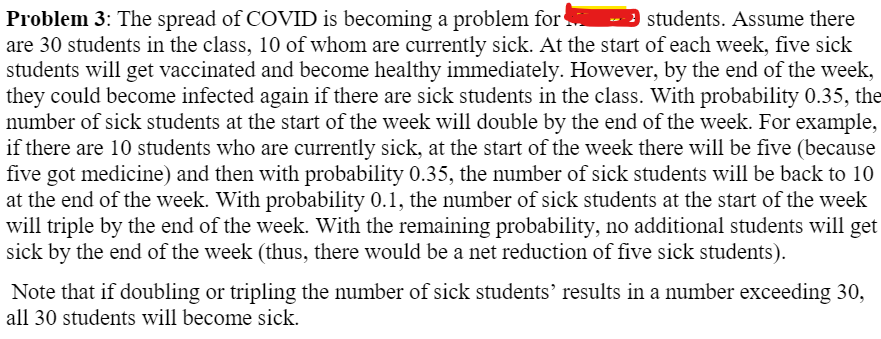
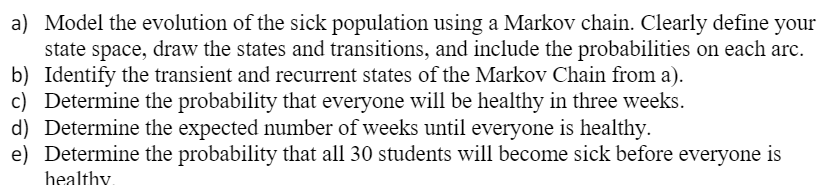
Problem 3: The spread of COVID is becoming a problem for - students. Assume there are 30 students in the class, 10 of whom are currently sick. At the start of each week, five sick students will get vaccinated and become healthy immediately. However, by the end of the week, they could become infected again if there are sick students in the class. With probability 0.35, the number of sick students at the start of the week will double by the end of the week. For example, if there are 10 students who are currently sick, at the start of the week there will be five (because five got medicine) and then with probability 0.35, the number of sick students will be back to 10 at the end of the week. With probability 0.1, the number of sick students at the start of the week will triple by the end of the week. With the remaining probability, no additional students will get sick by the end of the week (thus, there would be a net reduction of five sick students). Note that if doubling or tripling the number of sick students' results in a number exceeding 30, all 30 students will become sick. a) Model the evolution of the sick population using a Markov chain. Clearly define your state space, draw the states and transitions, and include the probabilities on each arc. b) Identify the transient and recurrent states of the Markov Chain from a). c) Determine the probability that everyone will be healthy in three weeks. d) Determine the expected number of weeks until everyone is healthy. e) Determine the probability that all 30 students will become sick before everyone is healthy Problem 3: The spread of COVID is becoming a problem for - students. Assume there are 30 students in the class, 10 of whom are currently sick. At the start of each week, five sick students will get vaccinated and become healthy immediately. However, by the end of the week, they could become infected again if there are sick students in the class. With probability 0.35, the number of sick students at the start of the week will double by the end of the week. For example, if there are 10 students who are currently sick, at the start of the week there will be five (because five got medicine) and then with probability 0.35, the number of sick students will be back to 10 at the end of the week. With probability 0.1, the number of sick students at the start of the week will triple by the end of the week. With the remaining probability, no additional students will get sick by the end of the week (thus, there would be a net reduction of five sick students). Note that if doubling or tripling the number of sick students' results in a number exceeding 30, all 30 students will become sick. a) Model the evolution of the sick population using a Markov chain. Clearly define your state space, draw the states and transitions, and include the probabilities on each arc. b) Identify the transient and recurrent states of the Markov Chain from a). c) Determine the probability that everyone will be healthy in three weeks. d) Determine the expected number of weeks until everyone is healthy. e) Determine the probability that all 30 students will become sick before everyone is healthy




