







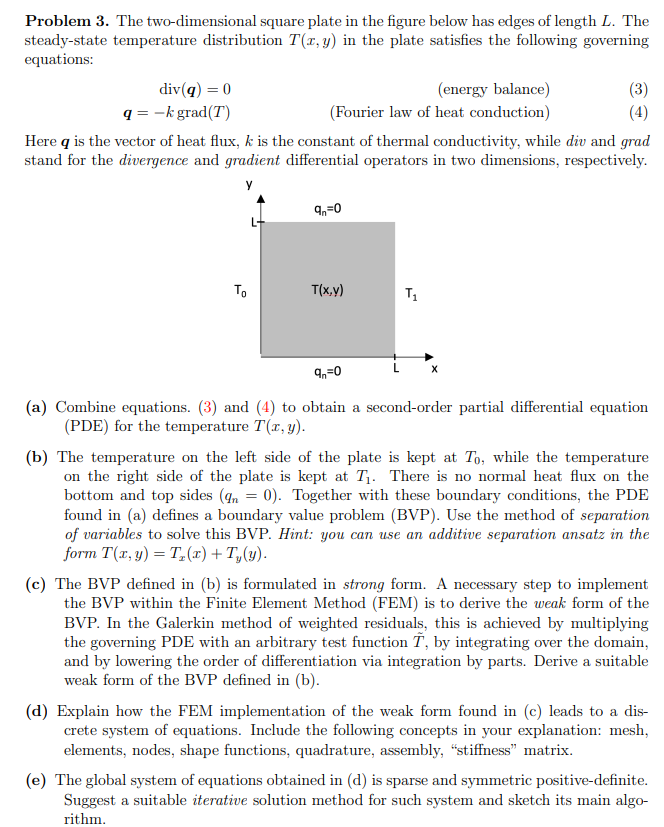
Question: Problem 3 . The two - dimensional square plate in the figure below has edges of length L . The steady - state temperature distribution
Problem The twodimensional square plate in the figure below has edges of length The
steadystate temperature distribution in the plate satisfies the following governing
equations:
div balance
kgrad law heat conduction
Here is the vector of heat flux, is the constant of thermal conductivity, while div and grad
stand for the divergence and gradient differential operators in two dimensions, respectively.
a Combine equations. and to obtain a secondorder partial differential equation
PDE for the temperature
b The temperature on the left side of the plate is kept at while the temperature
on the right side of the plate is kept at There is no normal heat flux on the
bottom and top sides Together with these boundary conditions, the PDE
found in a defines a boundary value problem BVP Use the method of separation
of variables to solve this BVP Hint: you can use an additive separation ansatz in the
form
c The BVP defined in b is formulated in strong form. A necessary step to implement
the BVP within the Finite Element Method FEM is to derive the weak form of the
BVP In the Galerkin method of weighted residuals, this is achieved by multiplying
the governing PDE with an arbitrary test function tilde by integrating over the domain,
and by lowering the order of differentiation via integration by parts. Derive a suitable
weak form of the BVP defined in b
d Explain how the FEM implementation of the weak form found in c leads to a dis
crete system of equations. Include the following concepts in your explanation: mesh,
elements, nodes, shape functions, quadrature, assembly, "stiffness" matrix.
e The global system of equations obtained in d is sparse and symmetric positivedefinite.
Suggest a suitable iterative solution method for such system and sketch its main algo
rithm.
Step by Step Solution
There are 3 Steps involved in it
1 Expert Approved Answer
Step: 1 Unlock

Question Has Been Solved by an Expert!
Get step-by-step solutions from verified subject matter experts
Step: 2 Unlock
Step: 3 Unlock
 Study Help