







Question: Problem 3. This problem pertains to poly(ethylene oxide) (PEO) chains having a molecular weight of 15,000g/mol. For PEO, use an estimate for a PEO Kuhn
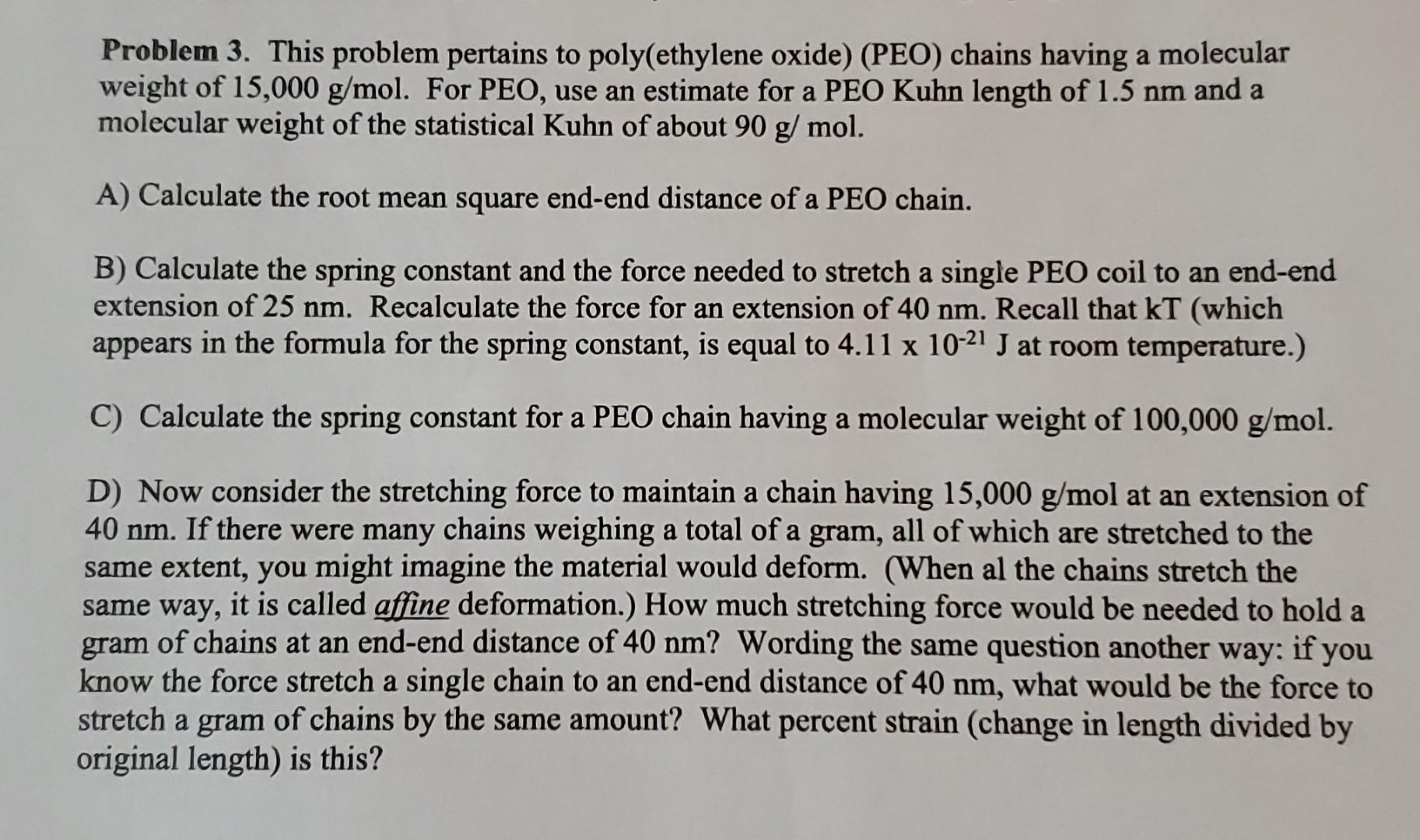
Problem 3. This problem pertains to poly(ethylene oxide) (PEO) chains having a molecular weight of 15,000g/mol. For PEO, use an estimate for a PEO Kuhn length of 1.5nm and a molecular weight of the statistical Kuhn of about 90g/mol. A) Calculate the root mean square end-end distance of a PEO chain. B) Calculate the spring constant and the force needed to stretch a single PEO coil to an end-end extension of 25nm. Recalculate the force for an extension of 40nm. Recall that kT (which appears in the formula for the spring constant, is equal to 4.111021J at room temperature.) C) Calculate the spring constant for a PEO chain having a molecular weight of 100,000g/mol. D) Now consider the stretching force to maintain a chain having 15,000g/mol at an extension of 40nm. If there were many chains weighing a total of a gram, all of which are stretched to the same extent, you might imagine the material would deform. (When al the chains stretch the same way, it is called affine deformation.) How much stretching force would be needed to hold a gram of chains at an end-end distance of 40nm ? Wording the same question another way: if you know the force stretch a single chain to an end-end distance of 40nm, what would be the force to stretch a gram of chains by the same amount? What percent strain (change in length divided by original length) is this
Step by Step Solution
There are 3 Steps involved in it

Get step-by-step solutions from verified subject matter experts
 Study Help