







Question: Problem 3: Utility Maximization Consider a binomial tree with u= 1.1,d = 0.94, So = 20 and r = 0.04. The physical probability is p
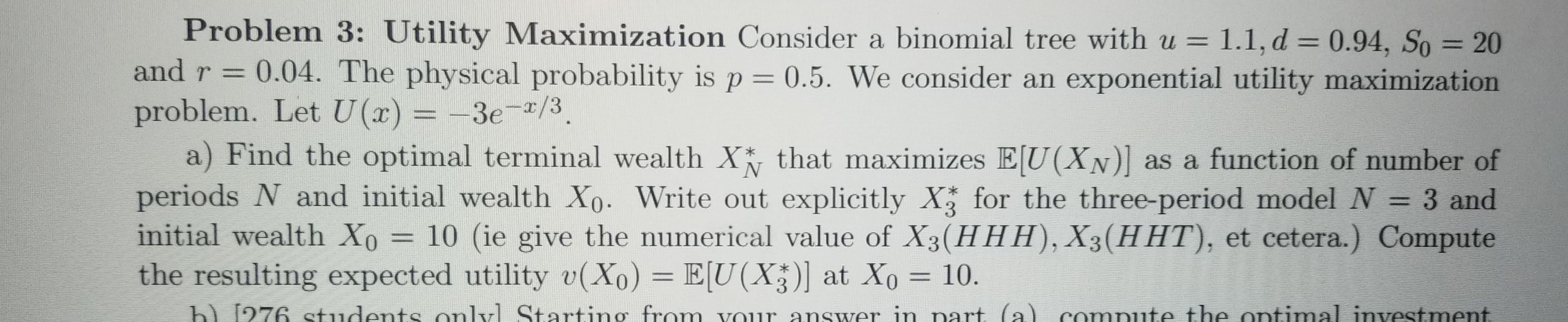
Problem 3: Utility Maximization Consider a binomial tree with u= 1.1,d = 0.94, So = 20 and r = 0.04. The physical probability is p = 0.5. We consider an exponential utility maximization problem. Let U(x) = -3e-2/3 a) Find the optimal terminal wealth X that maximizes E[U(XN)] as a function of number of periods N and initial wealth Xo. Write out explicitly X; for the three-period model N = 3 and initial wealth X0 = 10 (ie give the numerical value of X3(HHH), X3(HHT), et cetera.) Compute the resulting expected utility v(Xo) = E(U(X3)] at Xo = 10. b) 1976 students only) Starting from your answer in part la compute the optimal investment Problem 3: Utility Maximization Consider a binomial tree with u= 1.1,d = 0.94, So = 20 and r = 0.04. The physical probability is p = 0.5. We consider an exponential utility maximization problem. Let U(x) = -3e-2/3 a) Find the optimal terminal wealth X that maximizes E[U(XN)] as a function of number of periods N and initial wealth Xo. Write out explicitly X; for the three-period model N = 3 and initial wealth X0 = 10 (ie give the numerical value of X3(HHH), X3(HHT), et cetera.) Compute the resulting expected utility v(Xo) = E(U(X3)] at Xo = 10. b) 1976 students only) Starting from your answer in part la compute the optimal investment
Step by Step Solution
There are 3 Steps involved in it

Get step-by-step solutions from verified subject matter experts
 Study Help