







Question: Problem 3. You are provided with the following information about a municipal wastewater treatment plant. This plant uses the traditional activated-sludge process. Assume the microorganisms
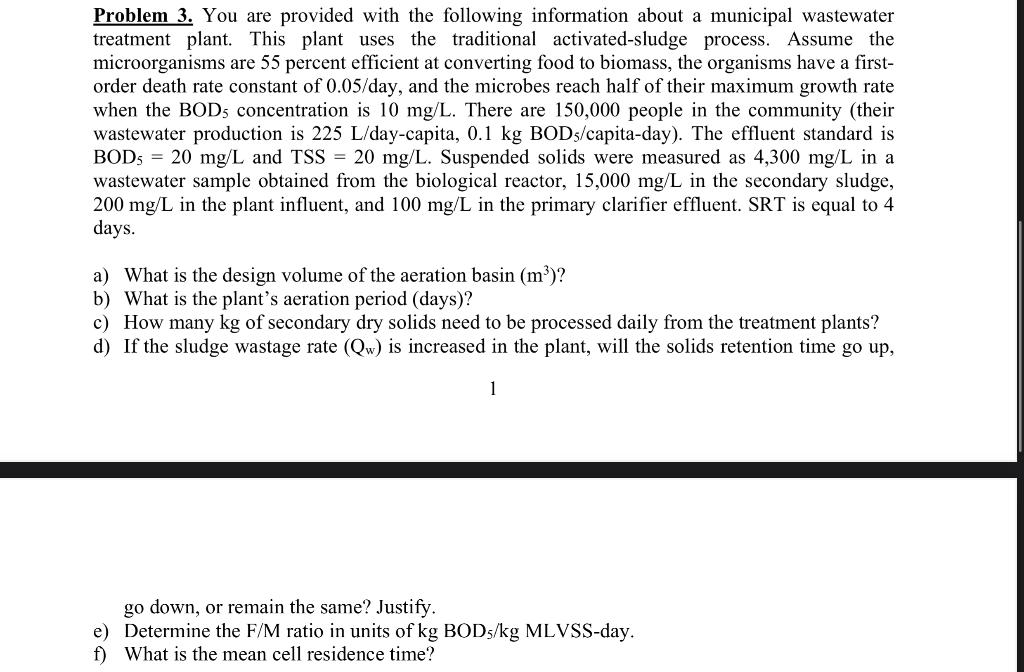
Problem 3. You are provided with the following information about a municipal wastewater treatment plant. This plant uses the traditional activated-sludge process. Assume the microorganisms are 55 percent efficient at converting food to biomass, the organisms have a first- order death rate constant of 0.05/day, and the microbes reach half of their maximum growth rate when the BODs concentration is 10 mg/L. There are 150,000 people in the community (their wastewater production is 225 L/day-capita, 0.1 kg BODs/capita-day). The effluent standard is BOD5 = 20 mg/L and TSS = 20 mg/L. Suspended solids were measured as 4,300 mg/L in a wastewater sample obtained from the biological reactor, 15,000 mg/L in the secondary sludge, 200 mg/L in the plant influent, and 100 mg/L in the primary clarifier effluent. SRT is equal to 4 days. a) What is the design volume of the aeration basin (m)? b) What is the plant's aeration period (days)? c) How many kg of secondary dry solids need to be processed daily from the treatment plants? d) If the sludge wastage rate (Qw) is increased in the plant, will the solids retention time go up, 1 go down, or remain the same? Justify. e) Determine the F/M ratio in units of kg BOD5/kg MLVSS-day. f) What is the mean cell residence time
Step by Step Solution
There are 3 Steps involved in it

Get step-by-step solutions from verified subject matter experts
 Study Help