



Question: Problem 3.21. Microscopic particles that are suspended in gas are driven from high temperature to low temperature regions. This process is called thermophoresis. In the
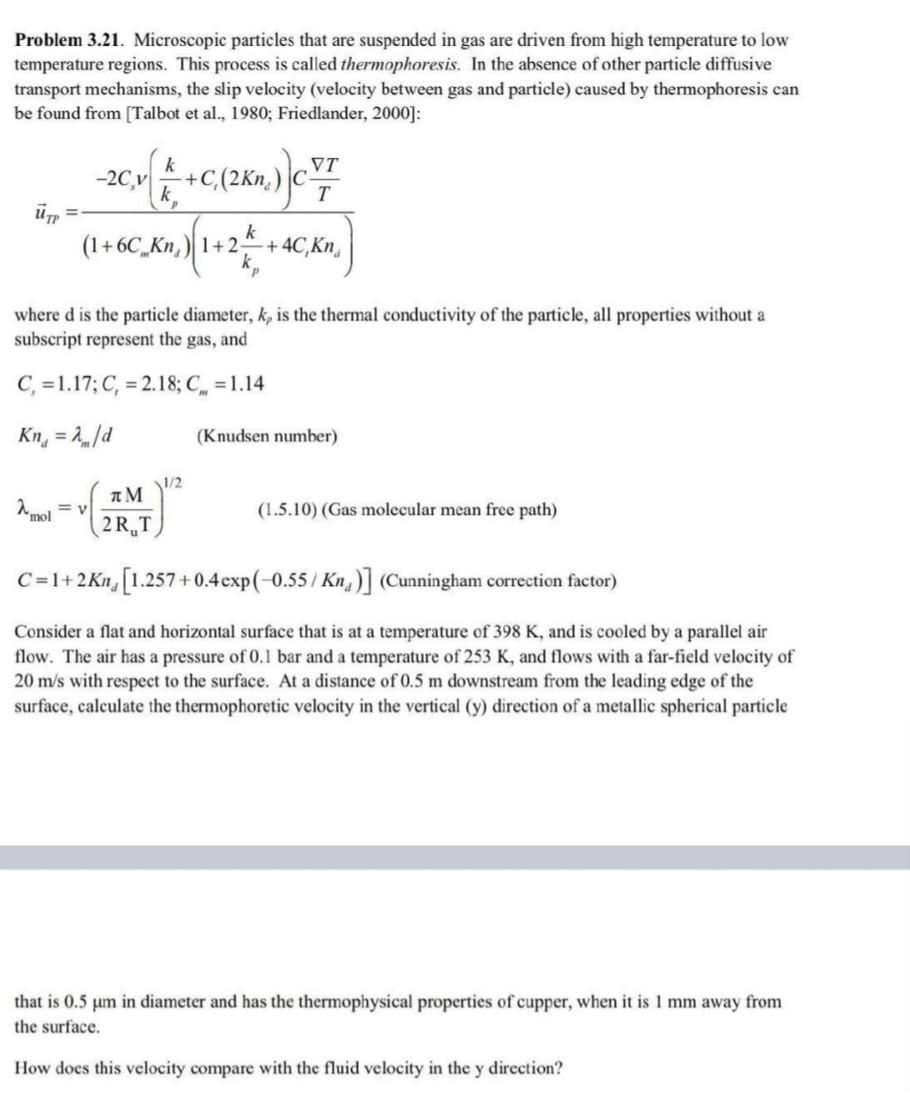
Problem 3.21. Microscopic particles that are suspended in gas are driven from high temperature to low temperature regions. This process is called thermophoresis. In the absence of other particle diffusive transport mechanisms, the slip velocity (velocity between gas and particle) caused by thermophoresis can be found from [Talbot et al., 1980; Friedlander, 2000]: uTP=(1+6CmKnd)(1+2kpk+4CtKnd)2Csv(kpk+Ct(2Knd))CTT where d is the particle diameter, kp is the thermal conductivity of the particle, all properties without a subscript represent the gas, and Cs=1.17;Ct=2.18;Cm=1.14Knd=m/d(Knudsennumber)mol=v(2RuTM)1/2(1.5.10)(Gasmolecularmeanfreepath)C=1+2Knd[1.257+0.4exp(0.55/Knd)](Cunninghamcorrectionfactor) Consider a flat and horizontal surface that is at a temperature of 398K, and is cooled by a parallel air flow. The air has a pressure of 0.1 bar and a temperature of 253K, and flows with a far-field velocity of 20m/s with respect to the surface. At a distance of 0.5m downstream from the leading edge of the surface, calculate the thermophoretic velocity in the vertical (y) direction of a metallic spherical particle that is 0.5m in diameter and has the thermophysical properties of cupper, when it is 1mm away from the surface. How does this velocity compare with the fluid velocity in the y direction
Step by Step Solution
There are 3 Steps involved in it

Get step-by-step solutions from verified subject matter experts