







Question: Problem 3.3: For a string x {0,1}*, let af denote the string obtained by changing all 0's to l's and all l's to O's in
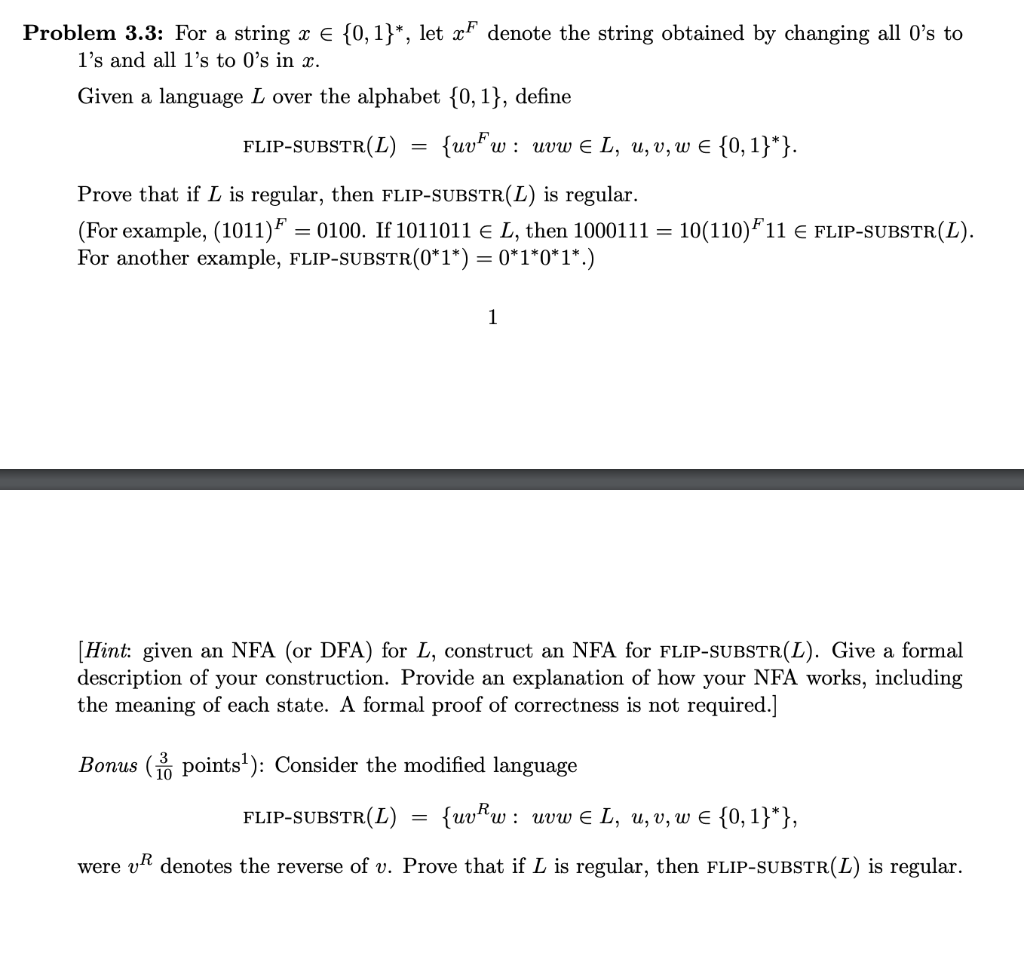
Problem 3.3: For a string x {0,1}*, let af denote the string obtained by changing all 0's to l's and all l's to O's in x. Given a language L over the alphabet {0,1}, define FLIP-SUBSTR(L) = {uvFw: Uvw E L, U, V, w {0, 1}*}. Prove that if L is regular, then FLIP-SUBSTR(L) is regular. (For example, (1011)F = 0100. If 1011011 e L, then 1000111 = 10(110) F11 FLIP-SUBSTR(L). For another example, FLIP-SUBSTR(0*1*) = 0*1*0*1*.) (Hint: given an NFA (or DFA) for L, construct an NFA for FLIP-SUBSTR(L). Give a formal description of your construction. Provide an explanation of how your NFA works, including the meaning of each state. A formal proof of correctness is not required.] Bonus ( points?): Consider the modified language FLIP-SUBSTR(L) = {uumw: Uvw EL, u, v, we {0,1}*}, were vR denotes the reverse of v. Prove that if L is regular, then FLIP-SUBSTR(L) is regular
Step by Step Solution
There are 3 Steps involved in it

Get step-by-step solutions from verified subject matter experts
 Study Help