







Question: Problem 3.4. Derivatives can be valued using risk neutral valuation. The spreadsheet Risk Neutral Valuation.clsr simulates 10,000 values of stock price (assuming log normal distri-
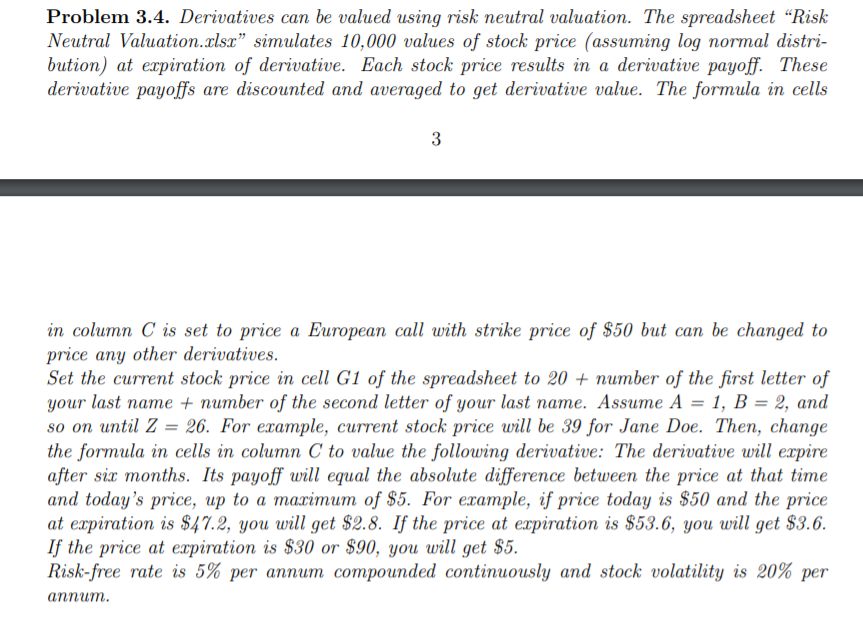
Problem 3.4. Derivatives can be valued using risk neutral valuation. The spreadsheet Risk Neutral Valuation.clsr" simulates 10,000 values of stock price (assuming log normal distri- bution) at expiration of derivative. Each stock price results in a derivative payoff. These derivative payoffs are discounted and averaged to get derivative value. The formula in cells in column C is set to price a European call with strike price of $50 but can be changed to price any other derivatives. Set the current stock price in cell G1 of the spreadsheet to 20 + number of the first letter of your last name + number of the second letter of your last name. Assume A = 1, B = 2, and so on until Z = 26. For example, current stock price will be 39 for Jane Doe. Then, change the formula in cells in column C to value the following derivative: The derivative will expire after six months. Its payoff will equal the absolute difference between the price at that time and today's price, up to a maximum of $5. For example, if price today is $50 and the price at expiration is $47.2, you will get $2.8. If the price at expiration is $53.6, you will get $3.6. If the price at expiration is $30 or $90, you will get $5. Risk-free rate is 5% per annum compounded continuously and stock volatility is 20% per annum. Problem 3.4. Derivatives can be valued using risk neutral valuation. The spreadsheet Risk Neutral Valuation.clsr" simulates 10,000 values of stock price (assuming log normal distri- bution) at expiration of derivative. Each stock price results in a derivative payoff. These derivative payoffs are discounted and averaged to get derivative value. The formula in cells in column C is set to price a European call with strike price of $50 but can be changed to price any other derivatives. Set the current stock price in cell G1 of the spreadsheet to 20 + number of the first letter of your last name + number of the second letter of your last name. Assume A = 1, B = 2, and so on until Z = 26. For example, current stock price will be 39 for Jane Doe. Then, change the formula in cells in column C to value the following derivative: The derivative will expire after six months. Its payoff will equal the absolute difference between the price at that time and today's price, up to a maximum of $5. For example, if price today is $50 and the price at expiration is $47.2, you will get $2.8. If the price at expiration is $53.6, you will get $3.6. If the price at expiration is $30 or $90, you will get $5. Risk-free rate is 5% per annum compounded continuously and stock volatility is 20% per annum
Step by Step Solution
There are 3 Steps involved in it

Get step-by-step solutions from verified subject matter experts
 Study Help