







Question: Problem: 3.4 Proof of expected utility property [for self-study] 0 Proposition 6 (Expected utility theory) Suppose that the rational preference relation f; on the space
![Problem: 3.4 Proof of expected utility property [for self-study] 0 Proposition](https://s3.amazonaws.com/si.experts.images/answers/2024/06/6677c9de702bc_4946677c9de4993c.jpg)
Problem:
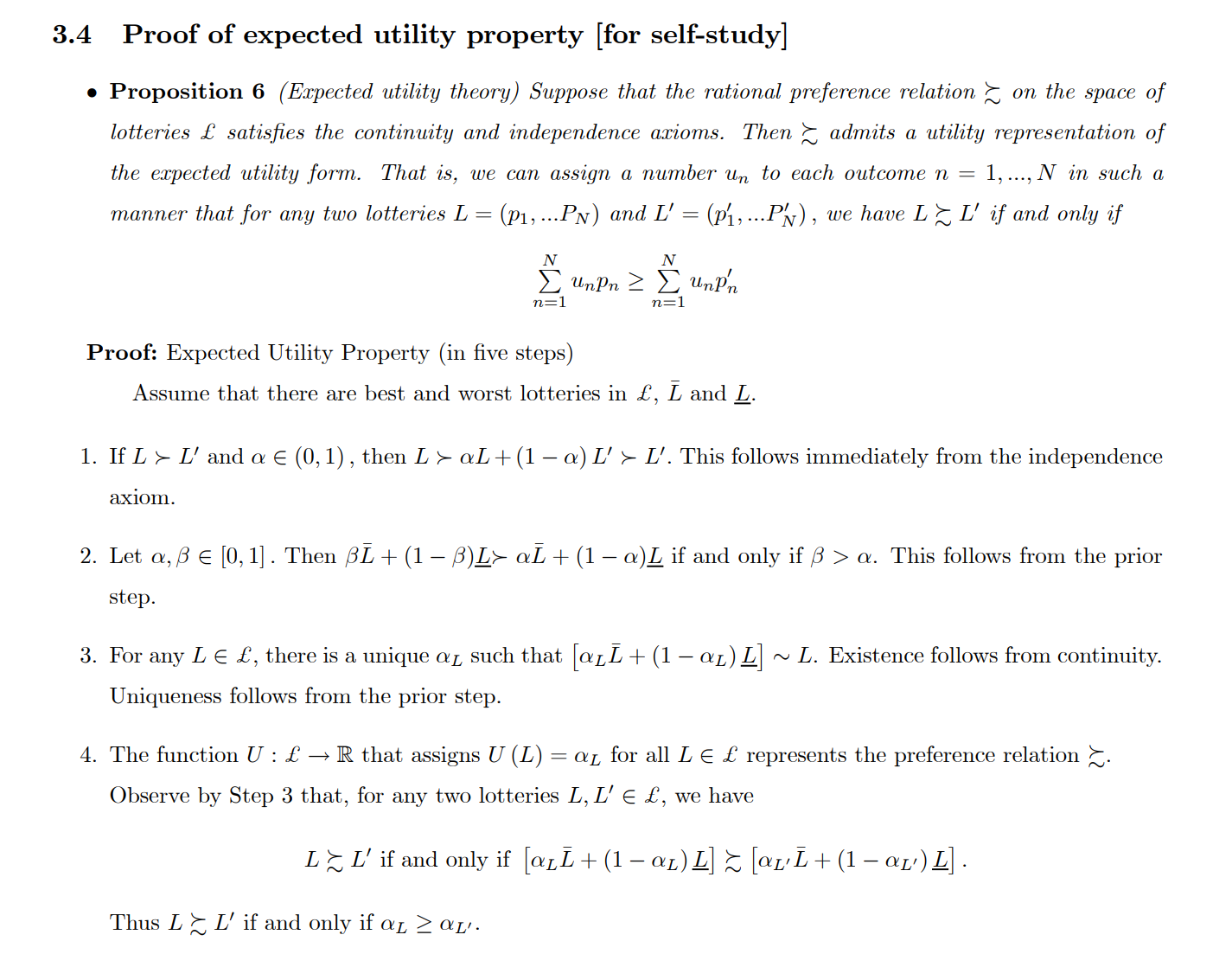
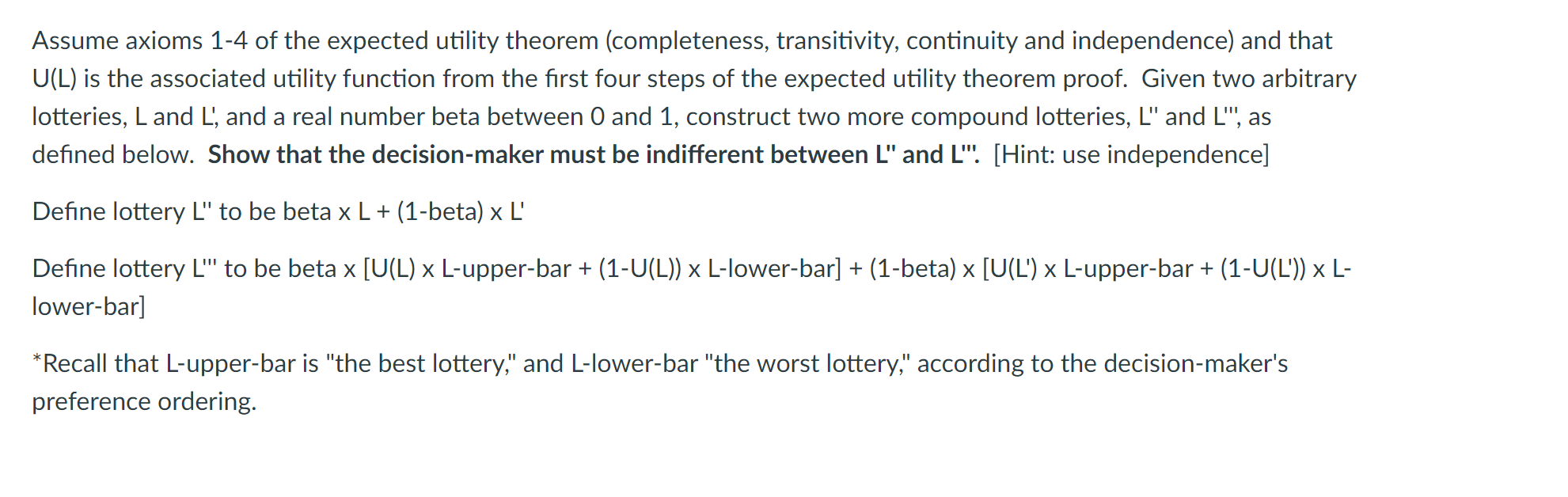
3.4 Proof of expected utility property [for self-study] 0 Proposition 6 (Expected utility theory) Suppose that the rational preference relation f; on the space of lotteries .5 satises the continuity and independence arioms. Then :3 admits a utility representation of the expected utility form. That is, we can assign a number nm to each outcome n = 1, ..., N in such a manner that for any two lotteries L = (p1j ...PN) and L' = (pi, NPR , we have L f; L' if and only if N N I 2 union 2 2 union 11:1 11:]. Proof: Expected Utility Property (in ve steps) Assume that there are best and worst lotteries in 1} , L and L. 1. If L > L' and o: E (U, 1) , then L >- (IL + (1 or) L' > L'. This follows immediately from the independence axiom. 2. Let 05,6 6 [0,1]. Then L + (1 i 5)L>- aL + (1 i oz)L if and only if 3 > (r. This follows from the prior step. 3. For any L E .8, there is a unique or]; such that [ocLL + (1 CEL) L] N L. Existence follows from continuity. Uniqueness follows from the prior step. 4. The function U : .8 > R that assigns U (L) = (:21, for all L E .13 represents the preference relation :3. Observe by Step 3 that, for any two lotteries L, L' E ,8, we have L g; L' if and only if [ocLL + (1 7 0113);] > [ant + (1 7 amp]. N Thus L f; L' if and only if orL 2 (1L1. Assume axioms 1-4 of the expected utility theorem (completeness, transitivity, continuity and independence) and that U(L) is the associated utility function from the first four steps of the expected utility theorem proof. Given two arbitrary lotteries, L and L', and a real number beta between 0 and 1, construct two more compound lotteries, L" and L", as defined below. Show that the decision-maker must be indifferent between L" and L". [Hint: use independence] Define lottery L" to be beta x L + (1-beta) x L' Define lottery L" to be beta x [U(L) x L-upper-bar + (1-U(L)) x L-lower-bar] + (1-beta) x [U(L') x L-upper-bar + (1-U(L')) x L- lower-bar] *Recall that L-upper-bar is "the best lottery," and L-lower-bar "the worst lottery," according to the decision-maker's preference ordering
Step by Step Solution
There are 3 Steps involved in it

Get step-by-step solutions from verified subject matter experts
 Study Help