







Question: Problem 3-57 Comprehensive Job-Order Costing Problem (LO 3-2, 3-4, 3-5, 3-6) Skip to question [The following information applies to the questions displayed below.] Scholastic Brass
Problem 3-57 Comprehensive Job-Order Costing Problem (LO 3-2, 3-4, 3-5, 3-6)
Skip to question
[The following information applies to the questions displayed below.] Scholastic Brass Corporation manufactures brass musical instruments for use by high school students. The company uses a normal costing system, in which manufacturing overhead is applied on the basis of direct-labor hours. The companys budget for the current year included the following predictions.
| Budgeted total manufacturing overhead | $ | 446,600 | |
| Budgeted total direct-labor hours (based on practical capacity) | 20,300 | ||
During March, the firm worked on the following two production jobs: Job number T81, consisting of 76 trombones Job number C40, consisting of 110 cornets The events of March are described as follows:
- One thousand square feet of rolled brass sheet metal was purchased on account for $5,000.
- Three hundred pounds of brass tubing was purchased on account for $3,000.
- The following requisitions were submitted on March 5: Requisition number 112: 250 square feet of brass sheet metal at $5 per square foot (for Job number T81) Requisition number 113: 1,000 pounds of brass tubing, at $10 per pound (for Job number C40) Requisition number 114: 10 gallons of valve lubricant, at $10 per gallon All brass used in production is treated as direct material. Valve lubricant is an indirect material.
- An analysis of labor time cards revealed the following labor usage for March. Direct labor: Job number T81, 800 hours at $20 per hour Direct labor: Job number C40, 900 hours at $20 per hour Indirect labor: General factory cleanup, $5,000 Indirect labor: Factory supervisory salaries, $8,000
- Depreciation of the factory building and equipment during March amounted to $12,000.
- Rent paid in cash for warehouse space used during March was $1,200.
- Utility costs incurred during March amounted to $2,000. The invoices for these costs were received, but the bills were not paid in March.
- March property taxes on the factory were paid in cash, $2,200.
- The insurance cost covering factory operations for the month of March was $3,100. The insurance policy had been prepaid.
- The costs of salaries and fringe benefits for sales and administrative personnel paid in cash during March amounted to $7,000.
- Depreciation on administrative office equipment and space amounted to $5,000.
- Other selling and administrative expenses paid in cash during March amounted to $1,000.
- Job number T81 was completed on March 20.
- Half of the trombones in Job number T81 were sold on account during March for $700 each.
The March 1 balances in selected accounts are as follows:
| Cash | $ | 10,000 | |
| Accounts Receivable | 21,000 | ||
| Prepaid Insurance | 5,000 | ||
| Raw-Material Inventory | 149,000 | ||
| Manufacturing Supplies Inventory | 400 | ||
| Work-in-Process Inventory | 91,000 | ||
| Finished-Goods Inventory | 220,000 | ||
| Accumulated Depreciation: Buildings and Equipment | 102,000 | ||
| Accounts Payable | 11,000 | ||
| Wages Payable | 8,000 | ||
![to question [The following information applies to the questions displayed below.] Scholastic](https://dsd5zvtm8ll6.cloudfront.net/si.experts.images/questions/2024/09/66ea9adbb87da_09966ea9adb57747.jpg)
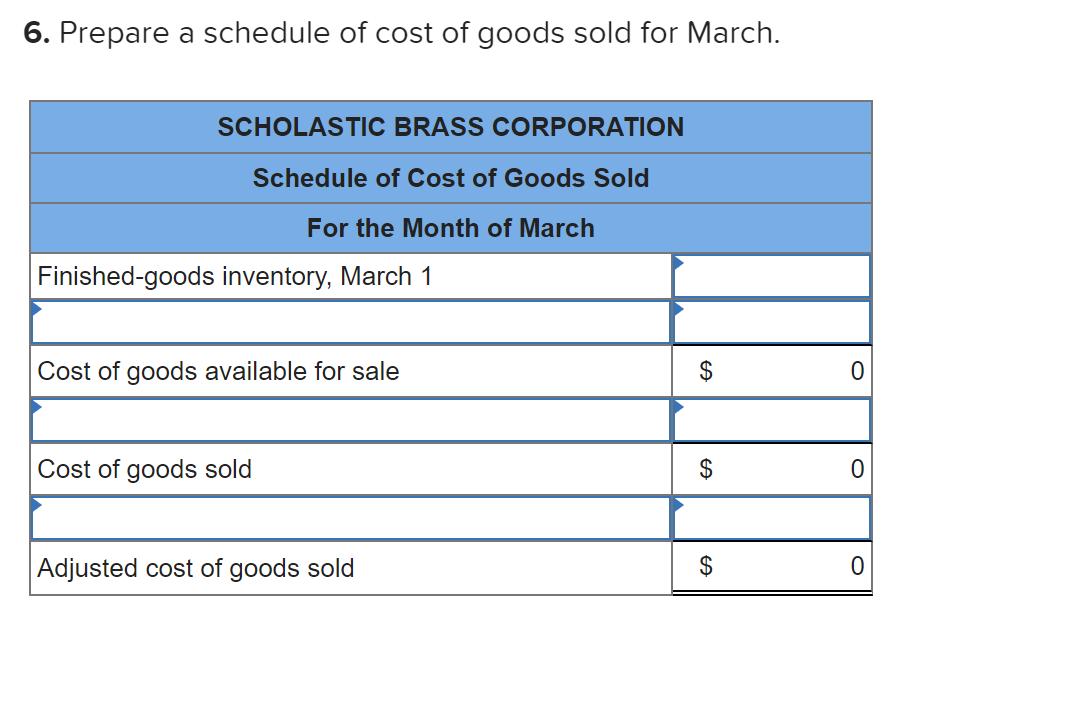
6. Prepare a schedule of cost of goods sold for March. 7. Prepare an income statement for March
Step by Step Solution
There are 3 Steps involved in it

Get step-by-step solutions from verified subject matter experts
 Study Help