







Question: Problem 3.6: (20 marks) An absorber is used to remove acetone from a nitrogen carrier gas. The feed, with acetone weight fraction of 0.213, enters
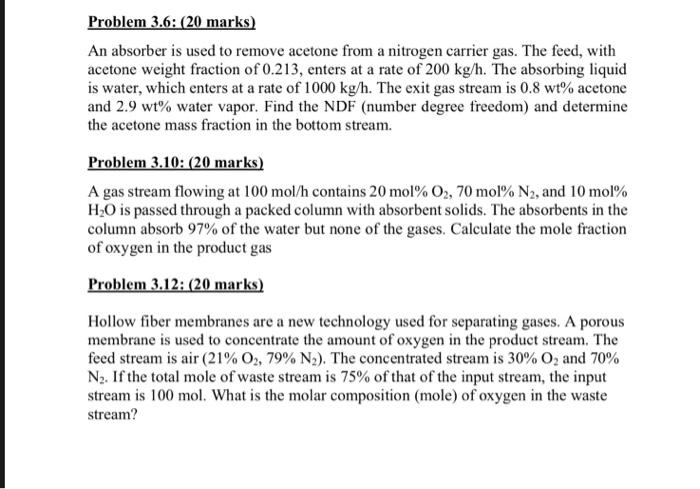
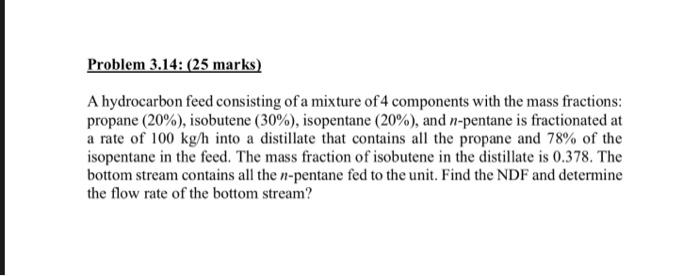
Problem 3.6: (20 marks) An absorber is used to remove acetone from a nitrogen carrier gas. The feed, with acetone weight fraction of 0.213, enters at a rate of 200 kg/h. The absorbing liquid is water, which enters at a rate of 1000 kg/h. The exit gas stream is 0.8 wt% acetone and 2.9 wt% water vapor. Find the NDF (number degree freedom) and determine the acetone mass fraction in the bottom stream. Problem 3.10: (20 marks) A gas stream flowing at 100 mol/h contains 20 mol% 02, 70 mol% N2, and 10 mol% H0 is passed through a packed column with absorbent solids. The absorbents in the column absorb 97% of the water but none of the gases. Calculate the mole fraction of oxygen in the product gas Problem 3.12: (20 marks) Hollow fiber membranes are a new technology used for separating gases. A porous membrane is used to concentrate the amount of oxygen in the product stream. The feed stream is air (21% 02, 79% N2). The concentrated stream is 30% O, and 70% N2. If the total mole of waste stream is 75% of that of the input stream, the input stream is 100 mol. What is the molar composition (mole) of oxygen in the waste stream? Problem 3.14: (25 marks) A hydrocarbon feed consisting of a mixture of 4 components with the mass fractions: propane (20%), isobutene (30%), isopentane (20%), and n-pentane is fractionated at a rate of 100 kg/h into a distillate that contains all the propane and 78% of the isopentane in the feed. The mass fraction of isobutene in the distillate is 0.378. The bottom stream contains all the n-pentane fed to the unit. Find the NDF and determine the flow rate of the bottom stream
Step by Step Solution
There are 3 Steps involved in it

Get step-by-step solutions from verified subject matter experts
 Study Help