







Question: Problem 3a Construct a 96% confidence interval estimate for the true population proportion of Variable 1's customers that have the attribute represented by the 1
Problem 3a Construct a 96% confidence interval estimate for the true population proportion of Variable 1's customers that have the attribute represented by the "1" code, based on the 20 data values you created for Variable 1 in your survey in Problem 1. Interpret your confidence interval.
3b. Referring to Problem 3a above, find the minimum number of customers that must be sampled in order for the 96% confidence interval estimate to be within 2% of the true population proportion Use the sample proportion from your survey in Problem 1, as the preliminary estimate of the true population proportion. Show all work
Problem 3c. What key assumption did you make in order to be able to use the formula shown in Problem 3a above? Is this assumption satisfied based on the 20 values you created for Variable 1 in Problem 1? Fully Explain.
Problem 3d.In general, what factors can affect the margin of error of the confidence interval estimate for a population proportion? Fully explain your answer.
Data from problem 1 is attached below
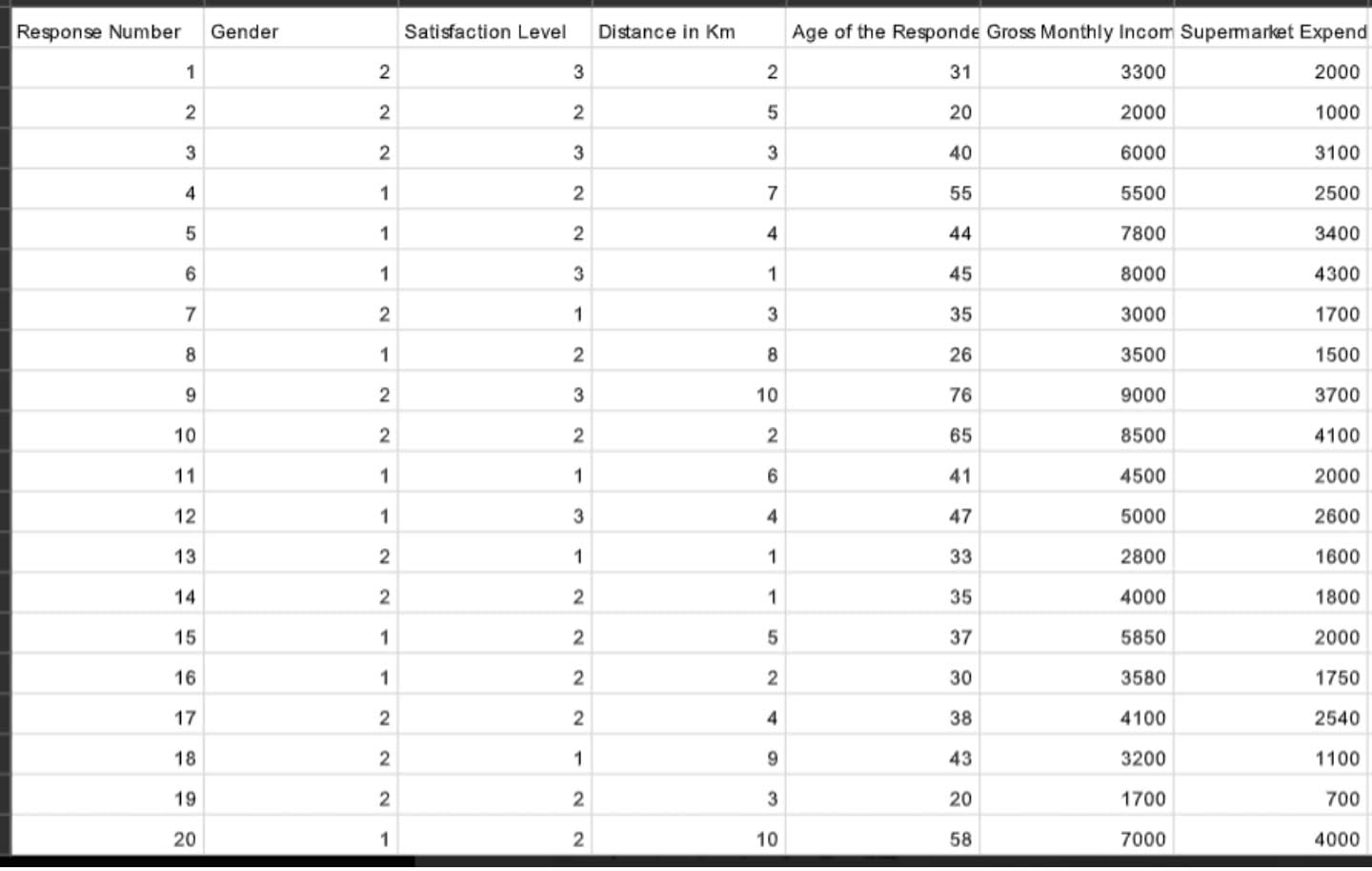
Response Number Gender Satisfaction Level Distance in Km Age of the Responds Gross Monthly Incom Supermarket Expend 2 3 2 31 3300 2000 N 2 N 5 20 2000 1000 2 3 40 6000 3100 A 2 7 55 5500 2500 N 44 7800 3400 45 8000 4300 N 35 3000 1700 N 26 3500 1500 N 10 76 9000 3700 10 N N N 65 8500 4100 11 41 4500 2000 12 A 47 5000 2600 13 N 33 2800 1600 14 N 35 4000 1800 15 N 37 5850 2000 16 N N 30 3580 1750 17 N N A 38 4100 2540 18 N CO 43 3200 1100 19 N N 20 1700 700 20 N 10 58 7000 4000
Step by Step Solution
There are 3 Steps involved in it

Get step-by-step solutions from verified subject matter experts
 Study Help