







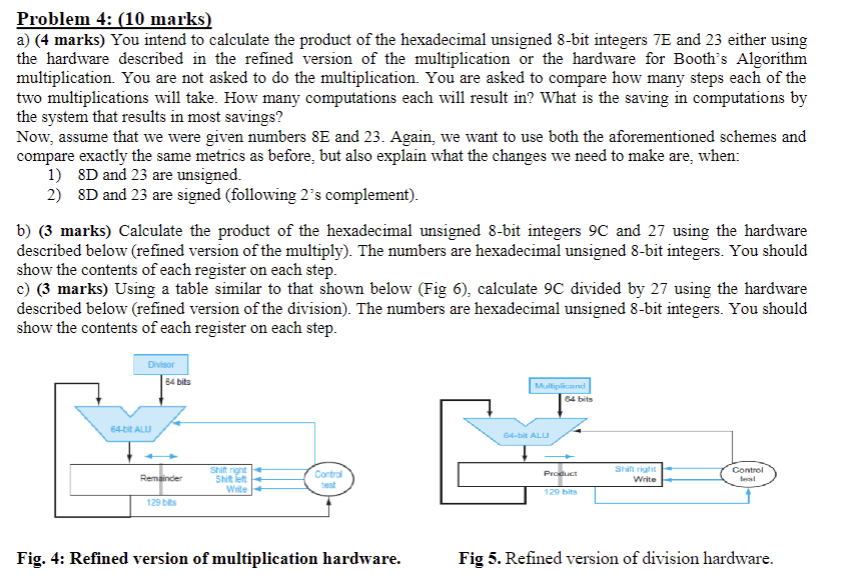
Question: Problem 4 : ( 1 0 marks ) a ) ( 4 marks ) You intend to calculate the product of the hexadecimal unsigned 8
Problem : marks
a marks You intend to calculate the product of the hexadecimal unsigned bit integers E and either using
the hardware described in the refined version of the multiplication or the hardware for Booth's Algorithm
multiplication. You are not asked to do the multiplication. You are asked to compare how many steps each of the
two multiplications will take. How many computations each will result in What is the saving in computations by
the system that results in most savings?
Now, assume that we were given numbers and Again, we want to use both the aforementioned schemes and
compare exactly the same metrics as before, but also explain what the changes we need to make are, when:
and are unsigned.
and are signed following s complement
b marks Calculate the product of the hexadecimal unsigned bit integers and using the hardware
described below refined version of the multiply The numbers are hexadecimal unsigned bit integers. You should
show the contents of each register on each step.
c marks Using a table similar to that shown below Fig calculate C divided by using the hardware
described below refined version of the division The numbers are hexadecimal unsigned bit integers. You should
show the contents of each register on each step.
Here is an example of an answer that doesn't help me: Step : Convert the hexadecimal numbers to binary: E hexbinaryhexbinary
Step : Perform multiplication using the refined version of multiplication or Booth's Algorithm for unsigned multiplication.
Step : Count the number of steps and computations required for each method.
Step : Compare the results to determine which method requires fewer computations and offers more savings.
For the second part of the question, involving signed and unsigned numbers, we would need to adjust the operations and considerations accordingly. Additionally, for the calculation of C divided by using the refined version of division hardware, we would follow a similar process, but this time using division operations instead of multiplication.
Step by Step Solution
There are 3 Steps involved in it
1 Expert Approved Answer
Step: 1 Unlock

Question Has Been Solved by an Expert!
Get step-by-step solutions from verified subject matter experts
Step: 2 Unlock
Step: 3 Unlock
 Study Help