







Question: Problem 4 ( 1 0 points ) : Consider the Internet over cable and the corresponding spectrum allocation. Refer to Textbook Figure 5 2 on
Problem points:
Consider the Internet over cable and the corresponding spectrum allocation. Refer to Textbook
Figure on Textbook page
a points Specify the bandwidth allocated for upstream data and that for downstream data.
b points Assume symbol per Hz what is maximum upstream bit rate and maximum
downstream bit rate?
c points In light of the cable system, explain very briefly the "ranging" process.
Problem points:
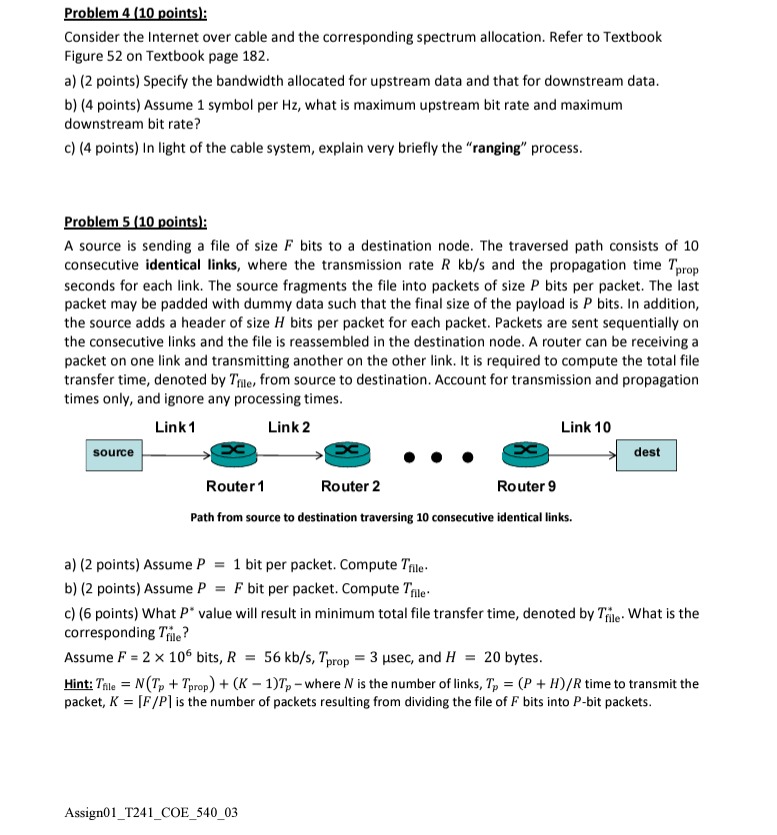
A source is sending a file of size bits to a destination node. The traversed path consists of
consecutive identical links, where the transmission rate and the propagation time
seconds for each link. The source fragments the file into packets of size bits per packet. The last
packet may be padded with dummy data such that the final size of the payload is bits. In addition,
the source adds a header of size bits per packet for each packet. Packets are sent sequentially on
the consecutive links and the file is reassembled in the destination node. A router can be receiving a
packet on one link and transmitting another on the other link. It is required to compute the total file
transfer time, denoted by from source to destination. Account for transmission and propagation
times only, and ignore any processing times.
a points Assume bit per packet. Compute
b points Assume bit per packet. Compute
c points What value will result in minimum total file transfer time, denoted by What is the
corresponding
Assume bits, and bytes.
Hint: where is the number of links, time to transmit the
packet, is the number of packets resulting from dividing the file of bits into bit packets.
Step by Step Solution
There are 3 Steps involved in it
1 Expert Approved Answer
Step: 1 Unlock

Question Has Been Solved by an Expert!
Get step-by-step solutions from verified subject matter experts
Step: 2 Unlock
Step: 3 Unlock
 Study Help