







Question: Problem 4 (10 points). Consider an oxygen molecule absorbed on a flat surface. Assume that there is no coupling between the translational, vibrational, and rotational
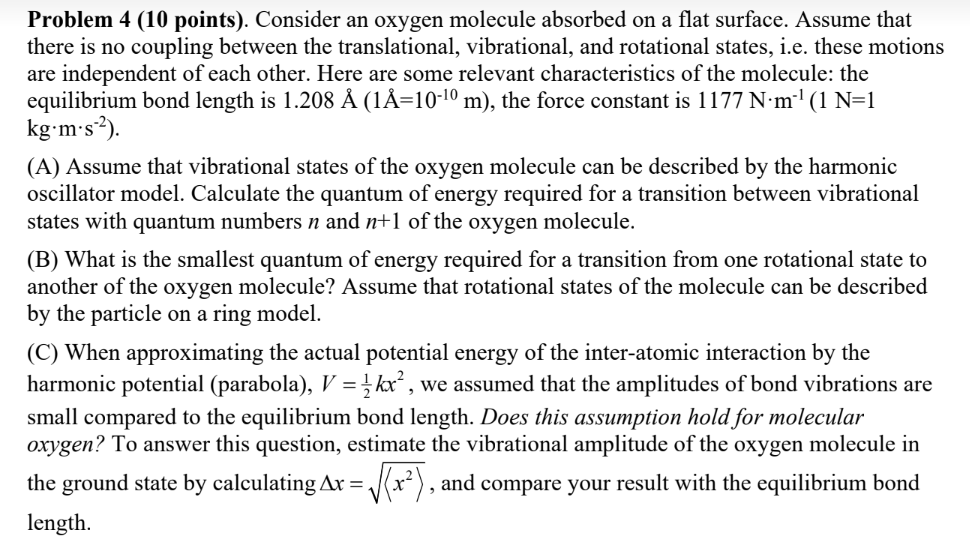
Problem 4 (10 points). Consider an oxygen molecule absorbed on a flat surface. Assume that there is no coupling between the translational, vibrational, and rotational states, i.e. these motions are independent of each other. Here are some relevant characteristics of the molecule: the equilibrium bond length is 1.208A(1A=1010m), the force constant is 1177Nm1(1N=1 kgms2) (A) Assume that vibrational states of the oxygen molecule can be described by the harmonic oscillator model. Calculate the quantum of energy required for a transition between vibrational states with quantum numbers n and n+1 of the oxygen molecule. (B) What is the smallest quantum of energy required for a transition from one rotational state to another of the oxygen molecule? Assume that rotational states of the molecule can be described by the particle on a ring model. (C) When approximating the actual potential energy of the inter-atomic interaction by the harmonic potential (parabola), V=21kx2, we assumed that the amplitudes of bond vibrations are small compared to the equilibrium bond length. Does this assumption hold for molecular oxygen? To answer this question, estimate the vibrational amplitude of the oxygen molecule in the ground state by calculating x=x2, and compare your result with the equilibrium bond length
Step by Step Solution
There are 3 Steps involved in it

Get step-by-step solutions from verified subject matter experts
 Study Help