







Question: Problem 4. (10 points): Loops. Consider the following x86-64 assembly code, called looped: looped: #a in trdi, n in-test movl s0, bedx test| |%esi, %esi
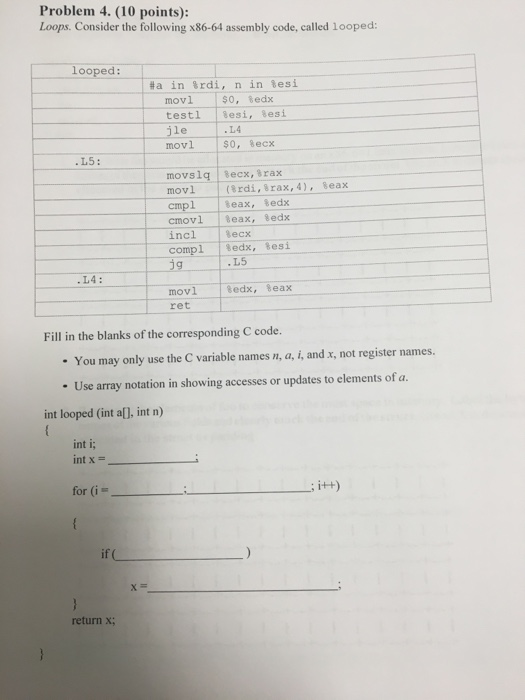
Problem 4. (10 points): Loops. Consider the following x86-64 assembly code, called looped: looped: #a in trdi, n in-test movl s0, bedx test| |%esi, %esi movi ISO, %ecx L5 : movslq Becx, Brax mov! | (trdi ,arax, 4), cmpl %eax incl ecx comp 1-Teda, tesi . L5 .L4: ret Fill in the blanks of the corresponding C code. - You may only use the C variable names n, a, i, and x, not register names. Use array notation in showing accesses or updates to elements of a int looped (int al]. int n) int i; for (i if return x Problem 4. (10 points): Loops. Consider the following x86-64 assembly code, called looped: looped: #a in trdi, n in-test movl s0, bedx test| |%esi, %esi movi ISO, %ecx L5 : movslq Becx, Brax mov! | (trdi ,arax, 4), cmpl %eax incl ecx comp 1-Teda, tesi . L5 .L4: ret Fill in the blanks of the corresponding C code. - You may only use the C variable names n, a, i, and x, not register names. Use array notation in showing accesses or updates to elements of a int looped (int al]. int n) int i; for (i if return x
Step by Step Solution
There are 3 Steps involved in it

Get step-by-step solutions from verified subject matter experts
 Study Help