



Question: Problem 4 (110 points). Consider the following CFG with the eight terminals: true, false, A, V, !, ==, (, and ). erpr true false exprerprerpr
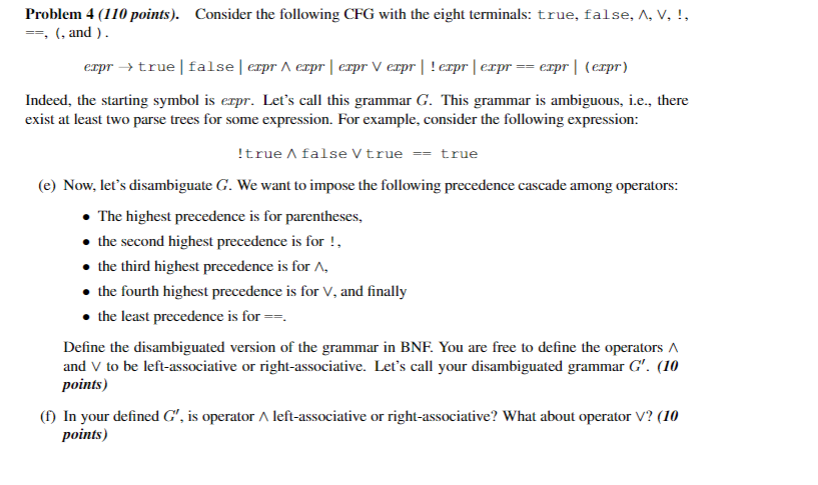
Problem 4 (110 points). Consider the following CFG with the eight terminals: true, false, A, V, !, ==, (, and ). erpr true false exprerprerpr Verpr | !erpr | expr == expr (erpr) Indeed, the starting symbol is erpr. Let's call this grammar G. This grammar is ambiguous, i.e., there exist at least two parse trees for some expression. For example, consider the following expression: !true false V true == true (e) Now, let's disambiguate G. We want to impose the following precedence cascade among operators: The highest precedence is for parentheses, the second highest precedence is for !, the third highest precedence is for A, the fourth highest precedence is for V, and finally the least precedence is for == Define the disambiguated version of the grammar in BNF. You are free to define the operators A and V to be left-associative or right-associative. Let's call your disambiguated grammar G'. (10 points) (f) In your defined G', is operator A left-associative or right-associative? What about operator V? (10 points)
Step by Step Solution
There are 3 Steps involved in it

Get step-by-step solutions from verified subject matter experts