



Question: Problem 4. (15 Suppose that Netflix is considering the design of its membership programs. There are three types of membership programs for customers: Basic, Standard,
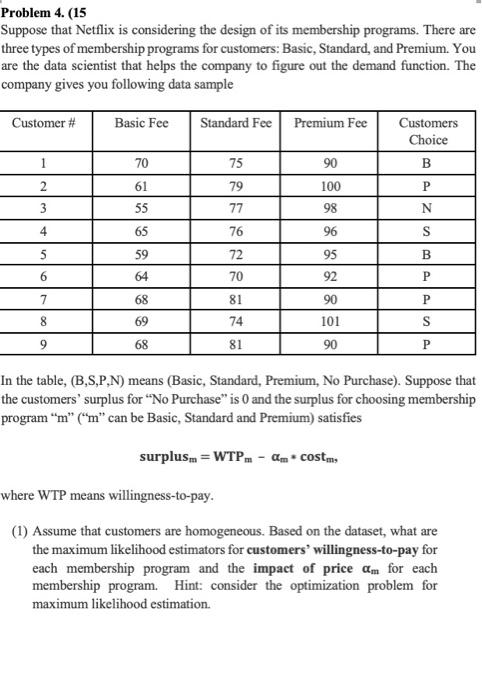

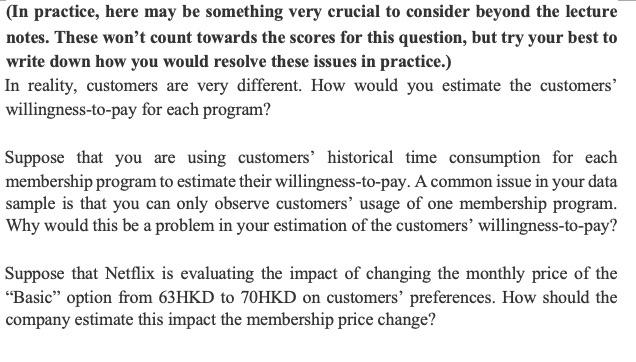
Problem 4. (15 Suppose that Netflix is considering the design of its membership programs. There are three types of membership programs for customers: Basic, Standard, and Premium. You are the data scientist that helps the company to figure out the demand function. The company gives you following data sample Customer # Basic Fee Standard Fee Premium Fee Customers Choice B 1 70 75 90 2 P 61 55 79 77 100 98 3 N 4 65 76 96 S 5 59 72 B 95 92 6 64 70 P 7 68 81 P 90 101 8 69 74 S 9 68 81 90 P In the table, (B,S,P.) means (Basic, Standard, Premium, No Purchase). Suppose that the customers' surplus for No Purchase" is 0 and the surplus for choosing membership program "m" ("m" can be Basic, Standard and Premium) satisfies surplusm= WTP. - Am. costm. where WTP means willingness-to-pay. (1) Assume that customers are homogeneous. Based on the dataset, what are the maximum likelihood estimators for customers willingness-to-pay for each membership program and the impact of price am for each membership program. Hint: consider the optimization problem for maximum likelihood estimation (2) What are the customers' probabilities of choosing each program? (In practice, here may be something very crucial to consider beyond the lecture notes. These won't count towards the scores for this question, but try your best to write down how you would resolve these issues in practice.) In reality, customers are very different. How would you estimate the customers' willingness-to-pay for each program? Suppose that you are using customers' historical time consumption for each membership program to estimate their willingness-to-pay. A common issue in your data sample is that you can only observe customers' usage of one membership program. Why would this be a problem in your estimation of the customers' willingness-to-pay? Suppose that Netflix is evaluating the impact of changing the monthly price of the "Basic" option from 63HKD to 70HKD on customers' preferences. How should the company estimate this impact the membership price change? Problem 4. (15 Suppose that Netflix is considering the design of its membership programs. There are three types of membership programs for customers: Basic, Standard, and Premium. You are the data scientist that helps the company to figure out the demand function. The company gives you following data sample Customer # Basic Fee Standard Fee Premium Fee Customers Choice B 1 70 75 90 2 P 61 55 79 77 100 98 3 N 4 65 76 96 S 5 59 72 B 95 92 6 64 70 P 7 68 81 P 90 101 8 69 74 S 9 68 81 90 P In the table, (B,S,P.) means (Basic, Standard, Premium, No Purchase). Suppose that the customers' surplus for No Purchase" is 0 and the surplus for choosing membership program "m" ("m" can be Basic, Standard and Premium) satisfies surplusm= WTP. - Am. costm. where WTP means willingness-to-pay. (1) Assume that customers are homogeneous. Based on the dataset, what are the maximum likelihood estimators for customers willingness-to-pay for each membership program and the impact of price am for each membership program. Hint: consider the optimization problem for maximum likelihood estimation (2) What are the customers' probabilities of choosing each program? (In practice, here may be something very crucial to consider beyond the lecture notes. These won't count towards the scores for this question, but try your best to write down how you would resolve these issues in practice.) In reality, customers are very different. How would you estimate the customers' willingness-to-pay for each program? Suppose that you are using customers' historical time consumption for each membership program to estimate their willingness-to-pay. A common issue in your data sample is that you can only observe customers' usage of one membership program. Why would this be a problem in your estimation of the customers' willingness-to-pay? Suppose that Netflix is evaluating the impact of changing the monthly price of the "Basic" option from 63HKD to 70HKD on customers' preferences. How should the company estimate this impact the membership price change
Step by Step Solution
There are 3 Steps involved in it

Get step-by-step solutions from verified subject matter experts