







Question: Problem 4 ( 2 0 % ) . This problem is based on problem 7 . 3 - 4 of chapter 7 of the Introduction
Problem This problem is based on problem of chapter of the
Introduction to Operations Research, Hillier and Lieberman ed textbook. Refer to
problem in the textbook and use SAS to solve the problem. Attach all the SAS
outputs below. Do not attach the full SASscreen.
Write out the mathematical model
Use SAS to solve the problem and write out the objective value and the optimal solution.
Attach the SAS outputs below.
Do sensitivity analysis and identify the allowable range for each cj coefficient. Explain
the allowable range for each cj coefficient. Attach the SAS outputs below.
Increase both cj coefficients, solve the problem again, and make sure that the optimal
solution does not change. Explain the method you used to solve the problem, so the
optimal solution is the same as that in section Write out the objective value and the
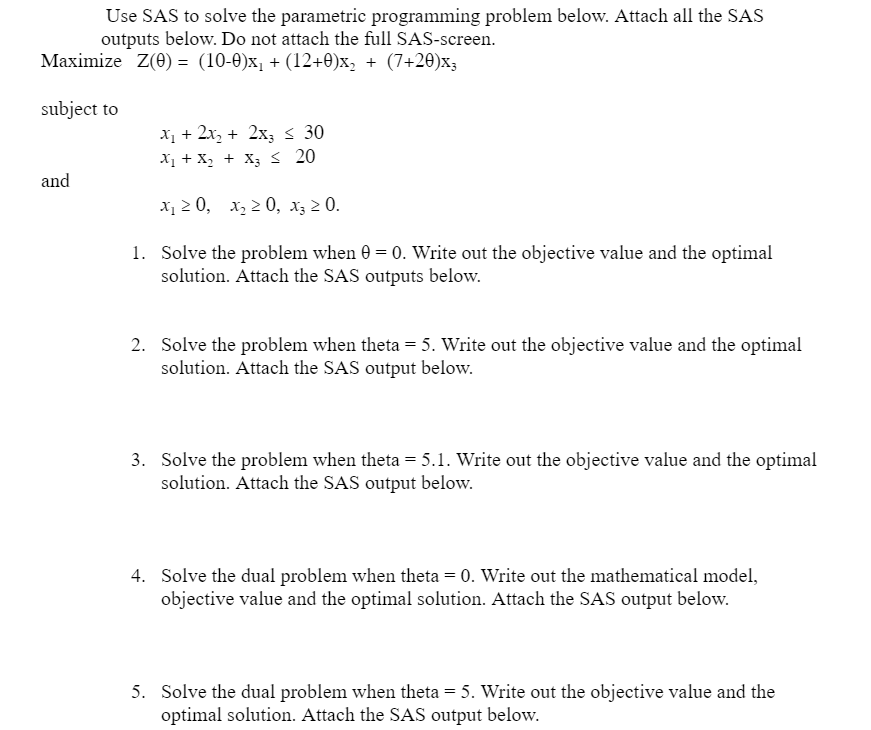
optimal solution.Use SAS to solve the parametric programming problem below. Attach all the SAS
outputs below. Do not attach the full SASscreen.
Maximize
subject to
and
Solve the problem when Write out the objective value and the optimal
solution. Attach the SAS outputs below.
Solve the problem when theta Write out the objective value and the optimal
solution. Attach the SAS output below.
Solve the problem when theta Write out the objective value and the optimal
solution. Attach the SAS output below.
Solve the dual problem when theta Write out the mathematical model,
objective value and the optimal solution. Attach the SAS output below.
Solve the dual problem when theta Write out the objective value and the
optimal solution. Attach the SAS output below.
Step by Step Solution
There are 3 Steps involved in it
1 Expert Approved Answer
Step: 1 Unlock

Question Has Been Solved by an Expert!
Get step-by-step solutions from verified subject matter experts
Step: 2 Unlock
Step: 3 Unlock
 Study Help