







Question: Problem 4. (20 points) In order to assess a person's (or a company's) exponential utility function, only one number, i.e., the risk tolerance R, needs
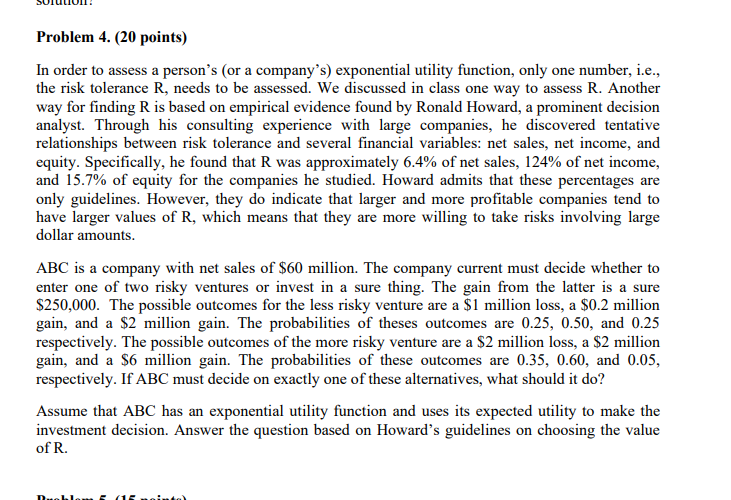
Problem 4. (20 points) In order to assess a person's (or a company's) exponential utility function, only one number, i.e., the risk tolerance R, needs to be assessed. We discussed in class one way to assess R. Another way for finding R is based on empirical evidence found by Ronald Howard, a prominent decision analyst. Through his consulting experience with large companies, he discovered tentative relationships between risk tolerance and several financial variables: net sales, net income, and equity. Specifically, he found that R was approximately 6.4% of net sales, 124% of net income, and 15.7% of equity for the companies he studied. Howard admits that these percentages are only guidelines. However, they do indicate that larger and more profitable companies tend to have larger values of R, which means that they are more willing to take risks involving large dollar amounts. ABC is a company with net sales of $60 million. The company current must decide whether to enter one of two risky ventures or invest in a sure thing. The gain from the latter is a sure $250,000. The possible outcomes for the less risky venture are a $1 million loss, a $0.2 million gain, and a $2 million gain. The probabilities of theses outcomes are 0.25, 0.50, and 0.25 respectively. The possible outcomes of the more risky venture are a $2 million loss, a $2 million gain, and a $6 million gain. The probabilities of these outcomes are 0.35, 0.60, and 0.05, respectively. If ABC must decide on exactly one of these alternatives, what should it do? Assume that ABC has an exponential utility function and uses its expected utility to make the investment decision. Answer the question based on Howard's guidelines on choosing the value of R
Step by Step Solution
There are 3 Steps involved in it

Get step-by-step solutions from verified subject matter experts
 Study Help