







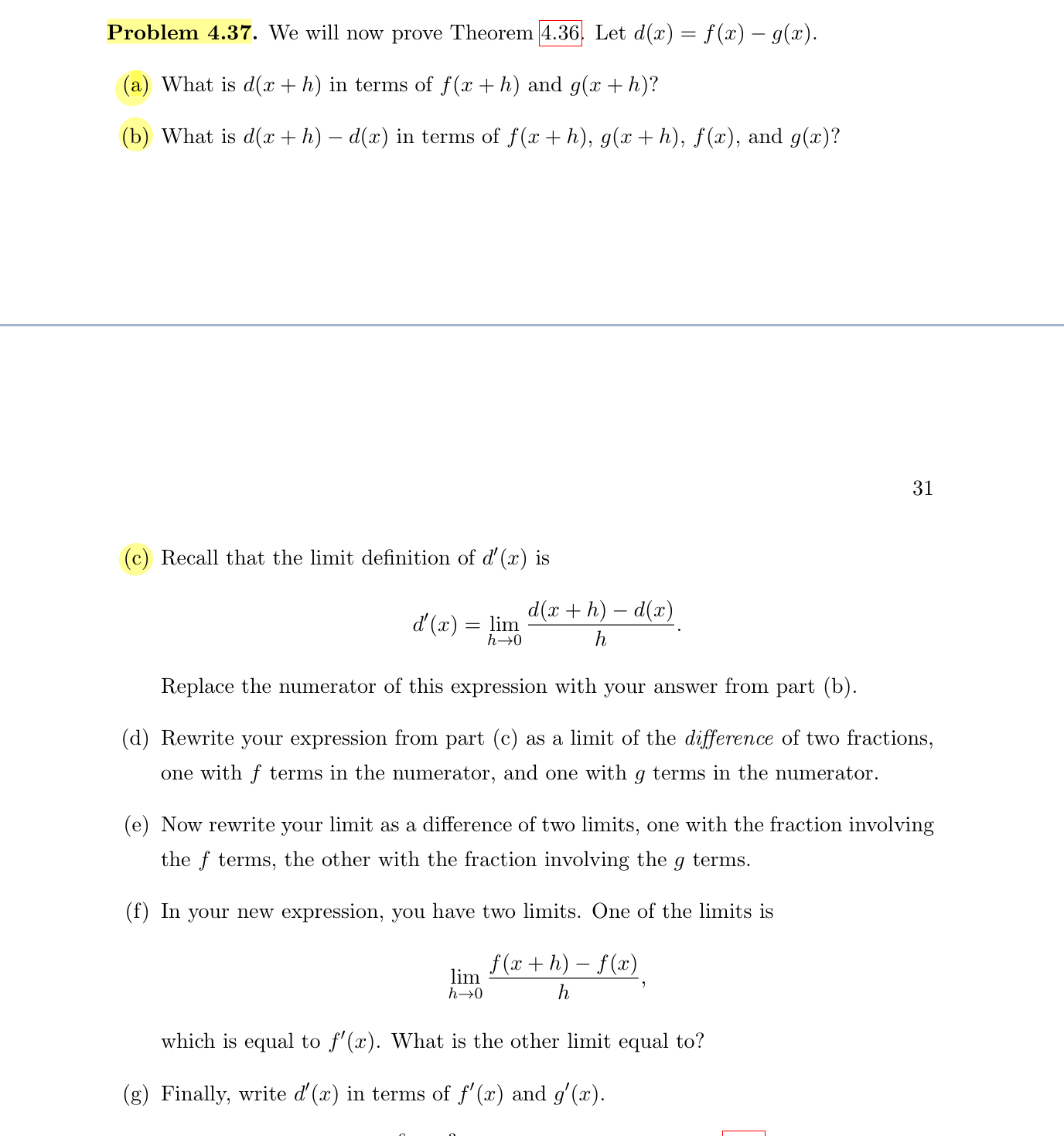
Question: Problem 4 . 3 7 . We will now prove Theorem 4 . 3 6 . Let d ( x ) = f ( x
Problem We will now prove Theorem Let
a What is in terms of and
b What is in terms of and
c Recall that the limit definition of is
Replace the numerator of this expression with your answer from part b
d Rewrite your expression from part c as a limit of the difference of two fractions, one with terms in the numerator, and one with terms in the numerator.
e Now rewrite your limit as a difference of two limits one with the fraction involving the terms, the other with the fraction involving the terms.
f In your new expression, you have two limits One of the limits is
which is equal to What is the other limit equal to
g Finally, write in terms of and
Step by Step Solution
There are 3 Steps involved in it
1 Expert Approved Answer
Step: 1 Unlock

Question Has Been Solved by an Expert!
Get step-by-step solutions from verified subject matter experts
Step: 2 Unlock
Step: 3 Unlock
 Study Help